Rear-end crashes happen every day. One minute you are sitting at a red light, and the next, you feel a sudden, jarring impact. If you have been injured in a rear-end collision, you need to know what to do if a car hits you from behind. Who pays for the medical bills? What if you miss work? What if the pain gets worse over time?
Our experienced Long Island car accident lawyers represent victims of rear-end collisions, and we understand the physical, emotional, and financial challenges you are facing. Call us for a no-obligation consultation. We're here to answer these questions and more.
- How Close Is Too Close?
- How Does New York's No-Fault System Work After a Rear-End Accident?
- Common Causes of Rear-End Crashes
- Common Injuries Caused By Rear-End Accidents
- What Damages Can You Recover After a Rear-End Collision?
- Who Is at Fault in a Rear-End Collision?
- Steps to Take After a Rear-End Collision
- Call Today for Help with Your Rear-End Collision Case
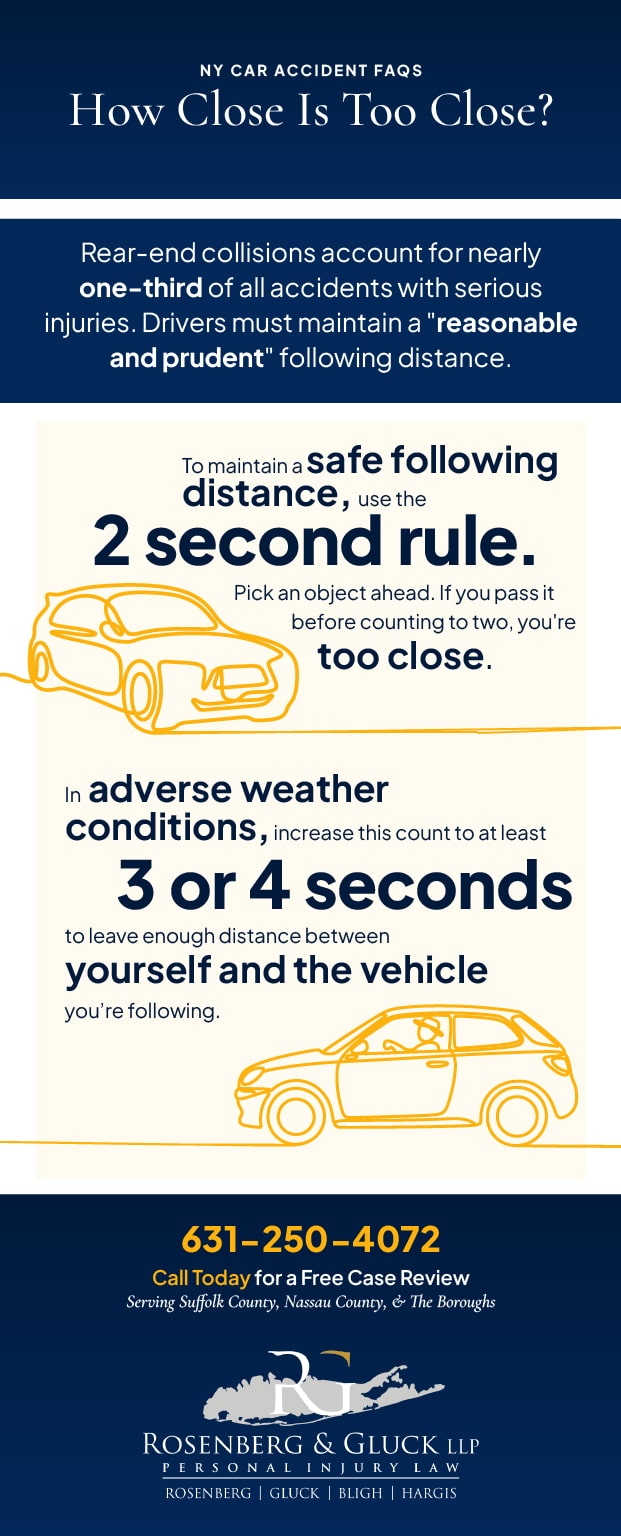
How Close Is Too Close?
Rear-end collisions are dangerous and common, representing nearly one-third of all motor vehicle accidents that result in serious injury. New York law requires a "reasonable and prudent" following distance based on speed and road conditions.
- The Two-Second Rule: The New York State Department of Motor Vehicles (NY DMV) suggests choosing an object ahead (like a sign or overpass) and counting, "one-thousand-one, one-thousand-two." You are too close if you pass that object before you finish.
- Adverse Conditions: In rain, snow, or when following large trucks, increase this count to at least three or four seconds to ensure you leave enough distance between yourself and the vehicle you are following.
How Does New York's No-Fault System Work After a Rear-End Accident?
New York is a no-fault state, meaning that all auto insurance policies include a minimum of $50,000 in no-fault insurance or personal injury protection (PIP). If you are injured in a rear-end accident, the PIP coverage of the vehicle you were in will cover economic losses like your medical bills, a portion of lost wages, and related necessities like travel expenses for medical visits.
It is important to note that insurance companies do not offer no-fault coverage to motorcyclists.
Common Causes of Rear-End Crashes
Most rear-end collisions occur when the leading vehicle moves slowly or stops, and the rear driver travels too close (tailgating) to the front vehicle, causing it to be hit from behind. Other factors include:
- Distracted Driving: This is a major cause of rear-end accidents. According to the NY DMV, activities like texting, using a cell phone, or scrolling through social media feeds are illegal activities that take a driver's attention off the road. Even a few seconds of distraction can lead to devastating consequences.
- Speeding: Driving too fast for road or traffic conditions can prevent a driver from stopping in time to avoid hitting the vehicle in front of them.
- Inclement Weather: Conditions like rain, snow, and ice can make roads slippery, reduce visibility, and increase stopping distances, contributing to rear-end accidents.
Common Injuries Caused By Rear-End Accidents
Whiplash is one of the most common injuries resulting from rear-end collisions, causing neck, back, and shoulder pain that can be delayed symptoms that can persist for weeks, months, or even years. Such injuries as traumatic brain injuries (concussions), herniated or bulging spinal discs, seatbelt-related rib and collarbone fractures, facial/dental injuries from airbag deployment, and psychological trauma like post-traumatic stress disorder (PTSD) are also common.
What Damages Can You Recover After a Rear-End Collision?
If you've been seriously injured in a car accident, you may be entitled to seek compensation for your injuries and losses beyond what's covered by PIP no-fault benefits. A personal injury lawyer can help you secure the maximum amount possible. Unlike some states, New York does not cap or limit the amount you may recover in a car accident lawsuit. There are three types of damages you can recover:
Economic Damages
These are easily calculated, out-of-pocket expenses like medical costs, property damage, and lost wages.
Non-Economic Damages
These are more subjective and harder to prove. They include compensation for pain and suffering, disfigurement, and loss of enjoyment of life.
Punitive Damages
These are not meant to compensate car accident victims but to punish the at-fault driver for reckless or intentional misconduct.
Who Is at Fault in a Rear-End Collision?
Though New York is a no-fault state, if your injuries and losses exceed the $50,000 covered by PIP, you may be able to pursue a claim against the at-fault driver to recover additional compensation for damages such as medical expenses, lost wages, and pain and suffering.
In a rear-end collision, the driver in the rear is usually at fault. This is often because they were inattentive, driving too fast for conditions, or tailgating. However, the leading driver can also be at fault. This might happen if they were driving recklessly, failed to use hazard lights when necessary, did not move a disabled vehicle from the road, stopped suddenly without warning, brake-checked, reversed unexpectedly, or changed lanes without signaling.
How Do You Prove Fault in a Rear-End Collision?
Your lawyer can help prove fault by determining whether the lead driver or the following driver was at fault based on the facts of the crash and gathering evidence to strengthen your personal injury claim, including eyewitness testimony, traffic camera footage, diagrams in the police accident report, photos of the scene showing skid marks or debris, and more. In some cases, expert testimony may also be needed to analyze the physical evidence or address possible vehicle design issues.
Steps to Take After a Rear-End Collision
After a rear-end collision, protect your right to full and fair compensation for severe injuries. To do this:
- Don't admit fault and don't apologize. If you were rear-ended, the other driver is usually responsible, with few exceptions. Admitting fault can be used against you in settlement negotiations or court cases.
- Get medical help. Seek medical attention for the injured person as soon as possible, either at the scene or in an emergency room. Some severe injuries (like head injuries) are not immediately apparent, and a medical record from the day of the accident is crucial for your diagnosis, treatment, and insurance claim. Watch for symptoms like dizziness, neck stiffness, headaches, fatigue, or numbness in your upper body.
- Report the accident to your insurance company. In New York, you must provide written notice of the accident to your own insurance company as soon as reasonably possible, typically within 30 days. This 30-day deadline is strict for accessing PIP benefits.
- File an official Report of Motor Vehicle Accident (MV-104) with the DMV within 10 days if the accident caused an injury, death, or more than $1,000 in property damage.
- Do not speak with the other driver's insurance adjuster. While they may seem friendly, their goal is to minimize your claim. You might unintentionally say something that harms your case. Let your car accident attorney handle all communications with insurance companies. Never accept a settlement offer without speaking to a lawyer first.
- Do not post on social media. Insurance companies and defense lawyers will look for information on your social media accounts to use against your claim.
- Hire a car accident attorney. After seeking medical attention, hiring an attorney is the most crucial step. An experienced car accident lawyer will protect you from the tactics of insurance companies and fight to get you the financial compensation you deserve for your losses.
Call Today for Help with Your Rear-End Collision Case
When you hire legal counsel for serious injuries caused by a rear-end car accident, you can focus on your recovery while we prove negligence, handle the insurance companies, and fight for a fair settlement. The attorneys in our law firm have extensive experience with rear-end collision cases and—in fatal accidents—wrongful death claims. Contact us for a free consultation and let us go to work for you.