Daylight Saving Time (DST) is the practice of setting clocks forward one hour in the spring and back one hour in the fall. Though only two states don't observe DST (Hawaii and most of Arizona), it has sparked significant debate across the country, with its impact on drivers emerging as a key concern. So why is DST dangerous for drivers? Our Long Island car accident lawyers explain why this gain or loss of an hour can be dangerous for drivers.
- What Is Daylight Saving Time?
- How Does Daylight Saving Time Affect Health?
- Increased Risk of Motor Vehicle Accidents on Long Island
- What Is the Impact on Drivers and Pedestrians?
- Public Health and Traffic Safety Concerns
- What Is Being Done in New York to Address These Issues?
- How Can Drivers Stay Safe After the Clocks Change?
- What to Do If You're Injured in an Accident After DST
What Is Daylight Saving Time?
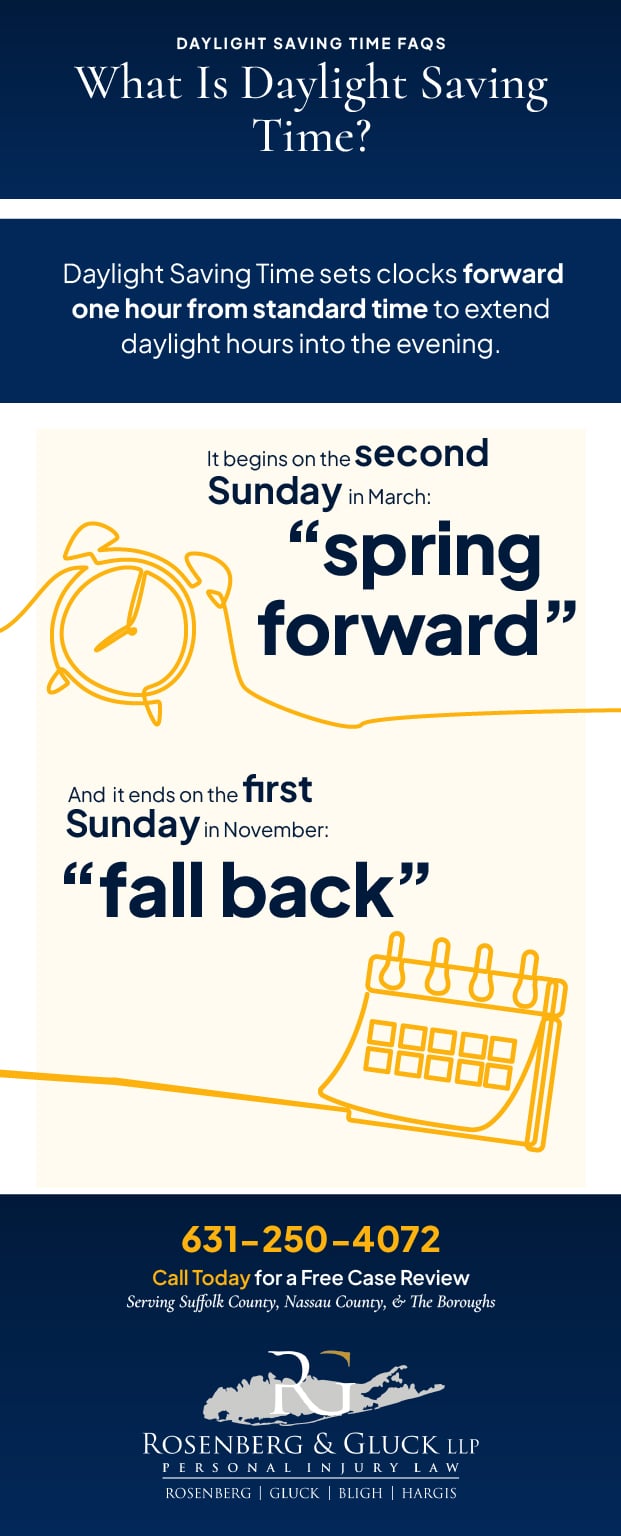
Daylight Saving Time (DST) sets clocks forward one hour from standard time to extend daylight hours into the evening. It begins on the second Sunday in March ("spring forward") and ends on the first Sunday in November ("fall back").
Why Was Daylight Saving Time Introduced?
According to the U.S. Department of War, daylight saving time—originally nicknamed "war time"— officially began in the United States on March 19, 1918, when the Standard Time Act was signed into law. It was introduced to add more light hours during the day to reduce energy costs during World War I. This law also created the five time zones we use today.
How Does Daylight Saving Time Affect Health?
The shift to Daylight Saving Time impacts sleep quality and can cause sleep deprivation. The disruption of the sleep-wake cycle can lead to a decrease in sleep duration and difficulty falling asleep, with a study from the Journal of Applied Psychology showing that individuals lose an average of 40 minutes of sleep with the lost hour on the Monday after the time change.
Disruptions in sleep patterns due to Daylight Saving Time schedules affecting sleep health productivity can lead to increased risks of mood disturbances, anxiety, and depression, as well as a rise in inflammatory markers in response to stress, increased risks of seasonal affective disorder (SAD), and a heightened risk for strokes.
The Sleep Foundation describes the body's internal clock, also known as circadian rhythm, as the regulator of our sleep-wake cycle according to light exposure. The sudden change in daylight hours during DST can cause difficulty falling asleep and waking up at the desired times.
The lost sleep during DST affects drivers' sleep patterns and can lead to fatigue and drowsiness while driving. This can result in more frequent traffic incidents, particularly fatal ones on the roads.
Increased Risk of Motor Vehicle Accidents on Long Island
According to News12 Long Island, car accidents on Long Island increased by 270% in the four weeks after the end of DST. In addition, a study by the National Institute of Health (NIH) found that the first Monday following the spring daylight saving adjustment sees an average of 83.5 auto accident deaths, compared to 78.2 deaths on any other Monday.
Darker mornings from losing an hour of sleep from DST can greatly affect driving ability. Drowsy driving is as dangerous as drunk driving, leading to slower reaction times, reduced awareness, and poor decision-making—increasing the risk of serious accidents.
In addition, with the sudden change in morning light, drivers may not be used to driving in darker conditions, increasing their risk for accidents. The study also found that there was no decrease in accidents after adjusting back to Standard Time.
What Is the Impact on Drivers and Pedestrians?
The end of Daylight Saving Time in the fall means more drivers find themselves on the road during dusk or darkness, which can greatly reduce visibility. Recognizing these dangers, the New York Governor’s Traffic Safety Committee amplifies the “Stay Awake, Stay Alive” public awareness campaign during the National Sleep Foundation’s Drowsy Driving Prevention Week each fall and the Annual Sleep Awareness Week in the spring to coincide with Daylight Savings Time changes.
Furthermore, peak commuter hours often coincide with peak deer activity (dawn and dusk), significantly increasing the likelihood of deer-vehicle collisions, according to New York's Department of Transportation (DOT).
Public Health and Traffic Safety Concerns
DST can also have negative effects on public health and traffic safety, in addition to the potential for increased motor vehicle accidents. The disruption of sleep patterns caused by DST has been linked to health risks, including an increase in workplace accidents, heart attacks, and strokes. Mental health issues such as depression, mood disorders, and anxiety may also be associated with less morning light.
Furthermore, studies show there is a higher incidence of pedestrian fatalities during the evening commute hours following the spring DST transition. This is because drivers may be less alert, and pedestrians may have trouble adjusting to darker conditions.
What Is Being Done in New York to Address These Issues?
New York continues to actively debate the elimination of biannual clock changes through multiple legislative avenues, though no final transition has occurred as of April 2026. New York, along with several other states, has introduced competing legislation to adopt permanent daylight saving time (Senate Bill S3380) or permanent standard time (Assembly Bill A3758).
How Can Drivers Stay Safe After the Clocks Change?
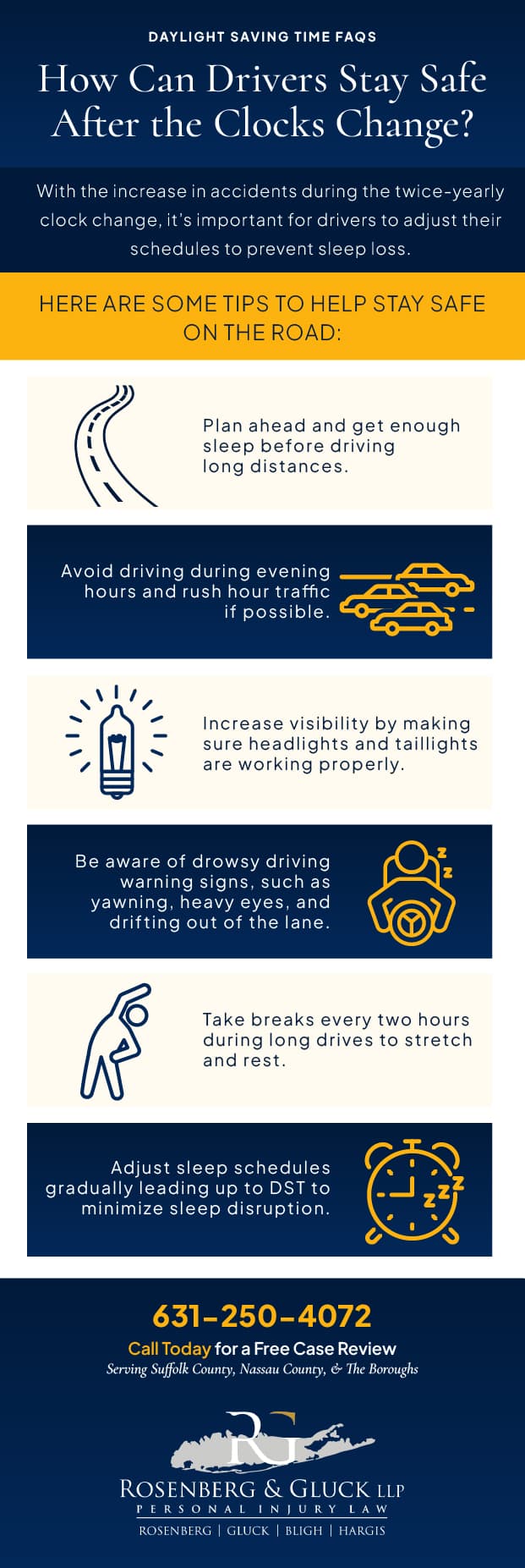
With the increase in accidents during the twice-yearly clock change, it is important for drivers to adjust schedules to prevent sleep loss. Here are some tips to help stay safe on the road:
- Plan ahead and get enough sleep before driving long distances.
- Avoid driving during evening hours and rush hour traffic if possible.
- Increase visibility by making sure headlights and taillights are working properly.
- Be aware of drowsy driving warning signs, such as yawning, heavy eyes, and drifting out of the lane.
- Take breaks every two hours during long drives to stretch and rest.
- Adjust sleep schedules gradually leading up to DST transition to minimize sleep disruption.
What to Do If You're Injured in an Accident After DST
If you’ve been injured in a car or pedestrian accident after DST, we are here to help. You may be entitled to compensation for medical bills, lost wages, and more. Contact us for a free consultation. We’ll review your situation, answer your questions, and guide you on the next steps to seek the compensation and support you deserve.