When you lose a loved one, financial questions shouldn't add to your pain. If you're wondering how wrongful death settlements are paid out, it's important to know that New York law governs the legal process for distributing funds to the decedent's family members.
A compassionate and experienced Long Island wrongful death lawyer can handle your New York wrongful death lawsuit, advising you every step of the way. Call us for a free consultation.
- What Happens First: The Wrongful Death Claim Process
- Who Receives the Wrongful Death Settlement Money?
- Forms of Payout: Lump Sum or Structured Settlement
- Timeline for Receiving Wrongful Death Settlement Funds
- Deductions from the Settlement Amount
- Tax Implications of Wrongful Death Settlements in New York
- Special Considerations for Minors
- New York's Statute of Limitations for Wrongful Death Claims
- How a Lawyer Helps With Your Wrongful Death Settlement Payout
- FAQs for How Are Wrongful Death Settlements Paid Out?
- Planning Your Family's Financial Future
What Happens First: The Wrongful Death Claim Process
Before any money is distributed, a valid wrongful death claim must be won. This means someone else's actions or carelessness caused your loved one's death.
By New York law (§ 5-4.1), the personal representative of the deceased person's estate is the party who files the lawsuit. This individual might be named in the will as an executor, or if there's no will, the court appoints an administrator for the estate. An estate is all the money and property owned by the person who died. A lawsuit for personal injuries is considered property of the decedent's estate. Even if your loved one had no other assets, an estate must be established with the court in order to pursue a case for injuries.
Your lawyer gathers evidence, such as police reports or medical records, to show negligence. If a motor vehicle accident was involved, obtaining traffic camera footage might be part of this investigation.
Once the fault is clear, negotiations for a settlement begin with the responsible party or their insurance company. If talks succeed, a settlement amount is agreed upon. This agreement outlines how the at-fault party pays out the wrongful death recovery funds. In New York, the person who can file a wrongful death suit is limited to the estate's personal representative of the deceased's estate, acting on behalf of the surviving immediate family members.
The initial payment usually goes into a special account (like a lawyer's trust account) or directly to the deceased person's estate.
Who Receives the Wrongful Death Settlement Money?
After a settlement is reached, the question of who gets the funds arises. The Surrogate's Court oversees the distribution of any funds and must approve the settlement and proposed distribution first. Money for pain and suffering is considered an asset of the estate, while an award for wrongful death is awarded directly to distributees of the estate.
How wrongful death and related pain and suffering settlements are paid out depends on a few things.
If your loved one had a will, the executor manages the estate and follows the will's instructions for distributing estate assets, including settlement funds for pain and suffering. If there was no will, New York's intestacy laws apply. These laws set an order for how relatives inherit.
The Surrogate's Court in New York oversees this entire process, so a judge must approve the settlement and the plan for how wrongful death settlement money distribution occurs among eligible family members, called distributees. These distributees are typically those who suffered financial losses due to the death. The court considers what a fair settlement is based on the extent of each person's financial and emotional loss.
Usually, a surviving spouse and children are first in line, followed by other family members like parents and siblings.
Covered Losses in a Wrongful Death Claim
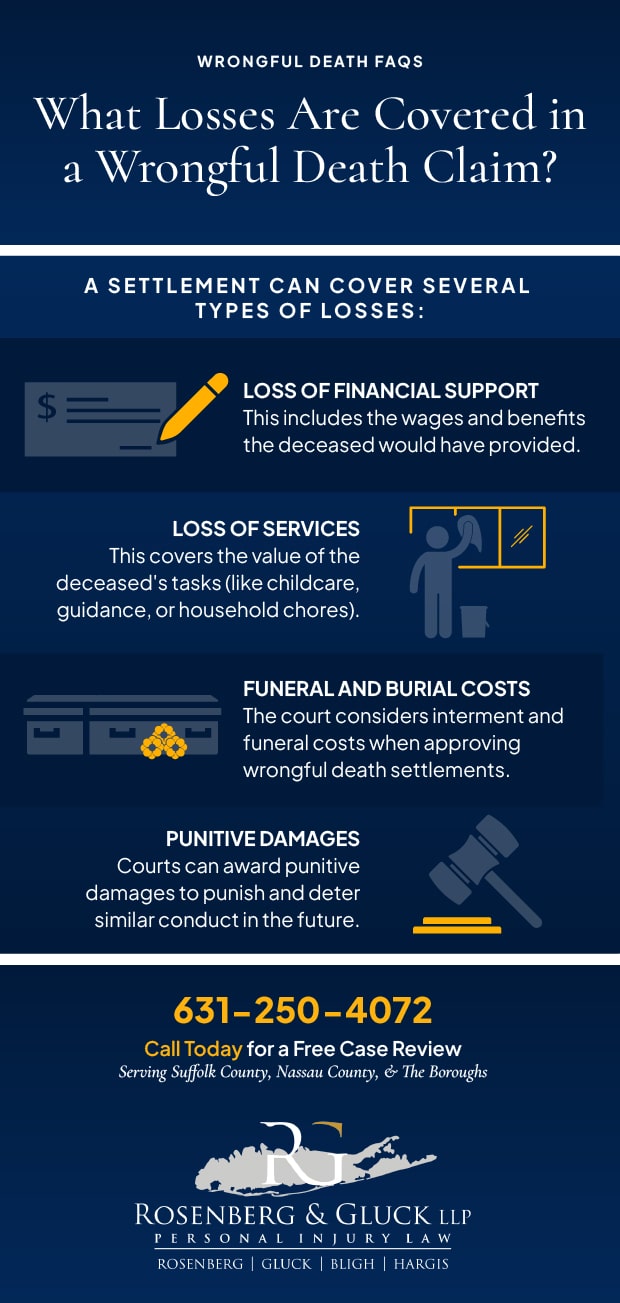
The settlement aims to cover different kinds of losses.
- Loss of Financial Support: This includes the wages and benefits the deceased would have provided.
- Loss of Services: This covers the value of the deceased's tasks (like childcare, guidance, or household chores).
- Funeral and Burial Costs: The settlement often reimburses these expenses. The court considers interment and funeral costs when approving how wrongful death settlements are paid out.
- Punitive Damages: Courts can award punitive damages that are intended to punish the defendant and deter similar conduct in the future.
Forms of Payout: Lump Sum or Structured Settlement
Once the total settlement amount is set and approved, you face another question about how wrongful death settlements are paid out. The funds might arrive as a single payment or as a series of payments over time. Each option has different features.
Lump Sum Payout
A lump sum payment means you receive all the wrongful death proceeds at once. You get a single, large payment that gives you immediate access to the entire settlement amount. This provides immediate financial relief, allowing you to pay off pressing debts, cover large expenses, or make investments.
Managing a large sum of money requires careful planning, and it's wise to consider how to make it last for the future needs of the victim's family and to avoid the risk of poor investment decisions.
Structured Settlement Payout
A structured settlement payout means the money is paid in a series of installments over a set period. This often involves an annuity, which is a financial product that is tax-free and guarantees regular payments.
Structured settlements provide a steady, predictable income stream. This offers long-term financial security, especially if the funds need to support children for many years. The downside is that you don't get all the money up front, which limits flexibility.
The decision between a lump sum and a structured settlement often depends on your family's specific financial situation and future needs. It also depends upon the allowance of the court and the parties involved in the settlement.
Timeline for Receiving Wrongful Death Settlement Funds
Receiving wrongful death funds isn't instant, even after a settlement is agreed upon. Several factors influence the timeline. The case's complexity plays a role, and reaching an agreement might take time.
After an agreement, the Surrogate's Court reviews and must approve the settlement and the distribution plan. This court-approval step adds time, especially if minor children are beneficiaries, as the court carefully reviews their best interests.
Another factor involves resolving any liens against the settlement. Liens are claims for repayment from parties like hospitals or government programs that covered medical expenses prior to death.
Deductions from the Settlement Amount
The agreed-upon settlement amount isn't what family members actually receive. Several deductions are made before the final payout, and understanding these can help set realistic expectations.
Attorney Fees and Costs
In New York, wrongful death lawyers typically work on a contingency fee basis. This means they receive a percentage of the settlement as their payment, and they only get paid if they win the case. You won't have to pay any upfront fees.
Case expenses are also deducted from the settlement. These are the costs incurred while building the claim, such as court filing fees, fees for obtaining medical records, and payments for investigators or expert witnesses. Your lawyer will provide an itemized list explaining these costs.
Liens and Reimbursements
Liens are legal claims against settlement funds. For example, if your loved one received medical treatment for the injuries that led to their death, the providers may place a lien on the settlement for any unpaid medical bills. Government programs like Medicare or Medicaid also have a right to be reimbursed if they covered any medical costs.
These liens are paid from the pain and suffering portion of the settlement. Funeral and burial costs paid out-of-pocket by the family are also typically reimbursed from the settlement funds.
Once the attorney fees, case expenses, and all valid liens have been paid, the remainder is the net settlement. This amount is then distributed to the beneficiaries according to the court-approved plan.
Tax Implications of Wrongful Death Settlements in New York
A common concern for beneficiaries is whether wrongful death settlement money is taxable. In New York, the rules are generally favorable. Most portions of a wrongful death settlement are not considered taxable income by the IRS or New York State.
Compensation for the physical injuries or sickness that led to the death is typically not taxable. Similarly, money awarded for the survivors' grief or the deceased's lost future earning potential is also generally tax-free.
However, any portion of the settlement specifically designated as lost wages that the deceased had already earned but not been paid may be subject to income tax. The specific categorization of the settlement funds determines their taxability.
It's always wise to consult a tax professional. They can review your settlement details and provide clear guidance on any potential tax obligations.
Special Considerations for Minors
When a minor child who was financially dependent on the deceased is a beneficiary in a wrongful death settlement, special rules apply to protect their financial future. The court ensures the child's portion of the settlement is managed responsibly.
Any settlement involving a minor must be approved by the Surrogate's Court. A judge will review the terms to confirm they are fair and in the child's best interest. The funds are typically not paid directly to the child or their parents without restrictions. Instead, the money is often placed into a protected account, like a court-ordered trust or a structured settlement annuity. These options provide payments to the child over time, usually beginning when they turn 18.
In some cases, the court may appoint a guardian to manage the funds on the child's behalf. These measures are designed to preserve the money for the child's future needs, such as education and living expenses.
New York's Statute of Limitations for Wrongful Death Claims
A statute of limitations is a law that sets a strict time limit for filing a lawsuit. Generally, if you miss this deadline, it means you lose your right to pursue a wrongful death claim and potentially recover compensation.
For wrongful death claims in New York, the statute of limitations is two years from the date of your loved one's death. This two-year deadline applies even if the death resulted from medical malpractice, making it critical to understand how the wrongful death statute of limitations affects your ability to file.
There's an even shorter, very specific deadline if a government entity is responsible. If you need to sue a municipality in New York (like a town in Long Island, Nassau County, or Suffolk County), you must first file a Notice of Claim within 90 days of the appointment of the estate's representative.
Missing this 90-day notice deadline bars your lawsuit against the municipality. A wrongful death lawyer helps you meet all deadlines and file paperwork properly and on time.
How a Lawyer Helps With Your Wrongful Death Settlement Payout
Navigating the aftermath of a loved one's death is incredibly challenging, and we provide valuable assistance during the settlement payout process.
Handling the Complex Legal Process
Wrongful death claims involve a lot of legal paperwork and procedures. We manage all court filings and meet every deadline, including the statute of limitations. We explain each step, including how wrongful death settlements are paid out, in clear and accessible terms you can understand.
We interact with the Surrogate's Court and other parties on your behalf, making sure your interests are protected at every stage.
Maximizing Your Compensation
We work to get your family the full compensation you deserve. We conduct a thorough investigation into your loved one's death, gathering evidence such as accident reports, witness statements, and video footage if available.
We accurately calculate all wrongful death damages, including lost income, loss of companionship, and other financial impacts. We use our experience to negotiate effectively with insurance companies and protect you from lowball tactics.
Managing Settlement Distribution
Once a settlement is reached, an experienced wrongful death attorney from our firm will continue to guide you every step of the way. We assist with the Surrogate's Court approval process and work to identify and resolve any liens against your settlement.
We oversee the correct and timely distribution of the net settlement funds to the rightful beneficiaries, and we make sure you understand exactly how your wrongful death settlement is paid out.
FAQs for How Are Wrongful Death Settlements Paid Out?
How Is a Wrongful Death Settlement Divided in New York?
The Surrogate's Court in New York determines how a wrongful death settlement is divided. It is usually distributed to eligible family members based on their financial losses and relationship to the deceased. The Surrogate’s Court must approve the final division of all settlement funds.
Compensation for the deceased's pain and suffering is considered an asset of their estate. If the deceased had a will, its terms guide the distribution. Without a will, state intestacy laws determine how these funds are divided among surviving family members.
Are Wrongful Death Settlements Considered Income for Tax Purposes?
Generally, the main part of a wrongful death settlement, which compensates for the death itself and the survivors' financial losses, is not considered taxable income.
However, if a portion of the settlement specifically covers wages the deceased earned, that part might be taxable. Always consult a tax advisor for personal advice.
Who Decides How Wrongful Death Settlement Money Is Distributed?
The Surrogate's Court in New York has the final authority to approve the distribution of wrongful death settlement money. While lawyers and family members propose a distribution plan based on state law and the specific losses, a judge reviews and authorizes it to ensure fairness and legality.
What Is the Average Time It Takes to Receive Wrongful Death Settlement Payouts?
The time it takes to receive wrongful death settlement payouts varies significantly, ranging from several months to over a year after an agreement is reached. The timeline is affected by factors such as the case's complexity, the need for court approval (especially when minors are involved), and the resolution of any liens.
If There Is No Will, How Is a Pain and Suffering Settlement Paid Out to Family?
If the deceased didn't have a will, New York's intestacy laws dictate how pain and suffering compensation (which is considered an asset of the deceased's estate) is paid out to family members. These laws establish a hierarchy of surviving relatives (e.g., spouse, children, parents) who are entitled to inherit the settlement proceeds.
Planning Your Family's Financial Future
Losing a loved one is incredibly difficult, creating both emotional and practical challenges, especially when negligence is involved.
While no amount of money can replace your loss, securing fair compensation is an important step in moving forward. The legal team at Rosenberg & Gluck, LLP has a deep understanding of New York's wrongful death laws and is here to fight for you.
We offer compassionate guidance and strong representation for families who file a wrongful death case. We will explain the legal process, including how settlements are paid, and we work tirelessly to protect your family's right to seek compensation.