
Most people assume that if a camera captured the accident, the footage is safe. This is a dangerous misconception. Store owners and homeowners are under no legal obligation to save traffic cam surveillance footage from a hit and run in Long Island, and without the right legal approach, they are under no obligation to hand it over to you.
To identify the driver, you must act immediately to preserve video evidence before it vanishes. In Long Island and Nassau County where hit-and-run incidents have risen, surveillance footage is typically the only link between a victim and the responsible party.
Most private security systems overwrite footage within 24 to 72 hours to save storage space, and municipal traffic cameras are not automatically stored for public review. Without a formal preservation demand sent by a lawyer immediately after the crash, the digital footprint of the vehicle that hit you can vanish permanently.
If you or a family member were injured in a hit-and-run, a free case evaluation with experienced Long Island hit and run accident lawyers from Rosenberg & Gluck, LLP can help clarify the following legal insights and your next steps on the road to justice.
For A Free Legal Consultation, Call

Key Takeaways for Surveillance Evidence
- Speed is the only variable that matters. Security systems loop their data quickly, sometimes in as little as 24 hours, meaning your evidence disappears if you wait too long to file a claim.
- You need a preservation letter immediately. This legal document stops the automatic deletion process and forces the owner to save the footage for your claim.
- We look beyond the obvious cameras. Ring doorbells, ATM cameras, and dashcams often catch the license plate numbers that standard traffic cameras miss.
Why You Need to Act Fast After a Hit-and-Run
Unlike physical debris, skid marks, or damage to a guardrail, digital evidence has an expiration date. In the immediate moments following a crash, the clock starts ticking on the servers and hard drives that hold the only image of the license plate you need.
What Is a Preservation Letter?
Store owners, homeowners, and even government entities are under no legal obligation to save footage for your benefit unless they are formally notified.
Legal professionals often use a legal tool known as a preservation letter, also called a spoliation letter. This document puts the owner of the footage on notice that a legal claim exists and that the specific video file is material evidence. Once a formal letter is received, deleting that evidence, even through an automated process, becomes a legal issue for them.
This creates a duty to preserve. Video evidence preservation becomes a legal obligation once this letter is received. If they destroy the footage after receiving this notice, they could face legal consequences for the spoliation of evidence.
The Timeline of Deletion
The urgency stems from the hardware limitations of modern surveillance systems. High-definition video takes up a massive amount of digital storage space. To manage costs, most systems are programmed to loop.
Private Systems (Ring, Nest, Arlo):
Unless the homeowner pays for a premium subscription, many of these systems do not save video at all. Even with a subscription, the retention period is usually between 30 and 60 days.
However, the greater risk is the homeowner manually deleting files to clear their notification feed. A preservation letter stops this.
Commercial Systems (Gas Stations, Strip Malls):
Business security systems are typically older and use physical hard drives (DVRs) rather than cloud storage. Depending on the size of the hard drive and the number of cameras recording, these systems might overwrite old footage in as little as 3 to 7 days. Once the system loops back to the beginning, the data is overwritten and typically unrecoverable.
Because of this, we send investigators to canvas the area immediately. We will focus on sightlines that police might have missed. Law enforcement is overburdened; they might check the camera directly pointing at the scene, but we look for the camera three blocks away that might have captured the car fleeing.
What Surveillance Infrastructure Actually Exists on Long Island?
Finding security cameras after a hit-and-run means navigating a patchwork of different technologies owned by different entities. Long Island is becoming increasingly monitored, but no single system covers the whole Island.
Nassau County Border Surveillance
Nassau County has heavily invested in license plate readers (LPRs) and video monitoring, particularly along the border with New York City. This is a response to vehicles fleeing between jurisdictions. If a hit-and-run occurs near the Queens border, there is a strong probability the vehicle passed through a checkpoint equipped with LPR technology.
These cameras convert the image of the license plate into searchable text data. This allows investigators to track a specific make and model leaving the county at a specific time, which narrows down the pool of suspects significantly.
Suffolk County and Municipal Investments
Suffolk County has also ramped up its technological assets. For example, the town of Smithtown has implemented high-tech surveillance in parks and waterways. While a hit-and-run is unlikely to happen inside a park, these cameras often monitor the entry and exit points. A driver fleeing a scene might cut through a public lot or park road to avoid main thoroughfares.
Furthermore, local departments like the Old Westbury Police Department have utilized StarChase technology. While this system is designed for active pursuits (launching a GPS tracker onto a fleeing vehicle), its adoption signals a broader shift. Police departments on the Island rely more and more on tech-heavy traffic enforcement. We will work to subpoena data from these municipal sources whenever a crash occurs in their jurisdiction.
The Reality of Red Light Security Cameras in a Hit and Run
One of the most common questions we hear is, “There was a red light camera there, surely it has the video?” The answer is, maybe. Red light cameras are triggered by specific events, like a car crossing the stop line after the light turns red.
They are not designed to act as 24/7 CCTV cameras that record continuous video of the intersection. If the hit-and-run driver had the green light when they hit you, the camera likely did not trigger.
However, we still analyze the intersection data. If the accident coincided with another driver running the light, or if the fleeing driver ran the light moments later, a photo may exist.
Using FOIL Requests to Access Government Camera Footage
When surveillance footage is owned by a government entity, whether it is a municipal traffic camera, a county-operated license plate reader, or a camera maintained by a state transportation authority, New York’s Freedom of Information Law (FOIL) gives you a legal right to request that data.
A FOIL request is a formal written demand submitted to the agency that controls the footage. The agency is required by law to respond within five business days, either by producing the records, acknowledging the request and providing a timeline, or explaining why the request is being denied.
However, FOIL has limitations that make speed critical. Agencies can deny requests if the footage is part of an active law enforcement investigation, which hit-and-run cases often are. They can also deny access if releasing the footage would interfere with judicial proceedings or compromise public safety.
The bigger issue is practical, not legal. Even when a FOIL request is valid, the agency has no obligation to preserve footage while processing your request. If their system overwrites the file before they respond, the footage is gone. This is why we pair every FOIL request with a preservation letter directed at the specific agency, creating a legal duty to hold the data while the request moves through their system.
We handle FOIL requests for Nassau County traffic systems, Suffolk County police departments, the Town of Hempstead, and the New York State Department of Transportation, among others. Each agency has its own records access officer and its own processing timeline, and we know how to navigate each one.
Residential and Commercial Nets
Major thoroughfares like Hempstead Turnpike or Sunrise Highway are densely packed with commercial businesses. In these areas, the net of surveillance is woven by the private sector. Fast food chains, banks, and gas stations have high-quality exterior cameras.
In suburban neighborhoods, the proliferation of doorbell cameras (Ring/Nest) has been a massive resource for accident reconstruction. These cameras are motion-activated. Even if the camera didn’t catch the impact, it might catch a car with front-end damage speeding down a side street two minutes later.
By piecing together footage from three or four houses, we may be able to determine the direction of flight and potentially get a clear shot of the license plate.
For A Free Legal Consultation, Call
How We Analyze the Footage to Prove Your Hit-and-Run Case
We have all seen television shows where a blurry image is magically enhanced to reveal a crystal-clear reflection in a pair of sunglasses. Real-world forensic video analysis does not work that way. Expecting 4K cinema-quality footage leads to disappointment, but that does not mean the footage is useless.
The Problem: Motion Blur and Compression
Surveillance cameras are designed to save space, which means they compress video files. This results in pixelation.
Furthermore, hit-and-run drivers move at high speeds. This creates motion blur, which makes the license plate look like a white smear across the screen. Nighttime conditions and glare from headlights further complicate the image.
The Solution: Forensic Review and Pattern Matching
When we recover footage, we often work with forensic analysts who use specialized software to stabilize frames and clarify images. However, when the plate is unreadable, we turn to pattern matching.
We use pattern matching to identify the vehicle through unique characteristics rather than the text on the plate. We look for:
- Aftermarket modifications: distinctive rims, spoilers, or exhaust tips.
- Damage profiles: Pre-existing dents, or new damage consistent with the impact (e.g., a missing passenger-side mirror).
- Stickers and decals: Bumper stickers or window decals are excellent identifiers.
- Lighting anomalies: A burnt-out headlight or fog light.
Cross-Referencing Physical Evidence
Video is rarely the sole piece of evidence. We combine video data with physical evidence left at the scene. If we find fragments of a headlight assembly or a side mirror, those plastic pieces often have part numbers stamped on them.
By identifying the part number, we can identify the exact make, model, and year range of the vehicle. If the video shows a grey sedan, and the part number belongs to a 2018-2020 Honda Accord, we have narrowed the suspect pool significantly. This allows police to look for a grey Honda Accord with missing parts, rather than just a grey car.
No Video? You Can Still Recover Compensation
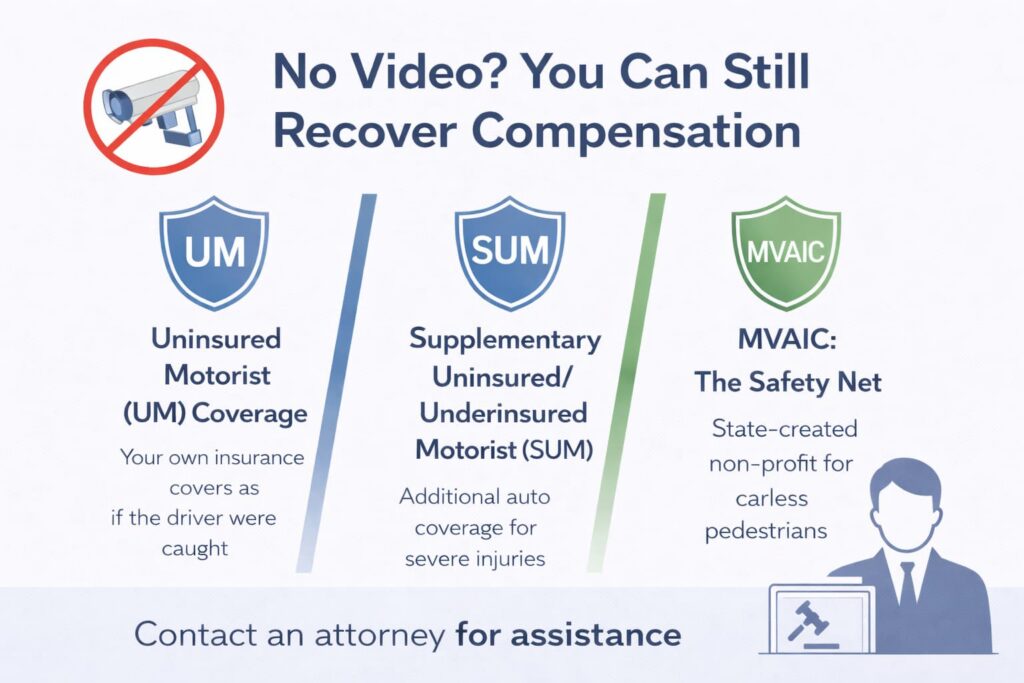
A common fear among hit-and-run victims is that if the driver is never found, or if no video exists, they are left to pay their own medical bills. This is a terrifying prospect, but it is not the reality in most cases. New York insurance laws specifically account for this scenario.
Uninsured Motorist (UM) Coverage
In New York, every auto insurance policy must include Uninsured Motorist (UM) coverage. In a hit-and-run where there is physical contact between your vehicle (or person) and the fleeing car, your own insurance policy steps in to pay as if the other driver had been caught and had insurance.
We view the insurance company as a business entity that requires strict proof. They need to verify that the accident truly happened and wasn’t a single-car error or a staged event. Our role is to provide the police reports, medical records, and witness statements that satisfy their requirements to release the funds.
Supplementary Uninsured/Underinsured Motorist (SUM)
If your injuries are severe, the basic UM limits might not be enough. If you have purchased Supplementary Uninsured/Underinsured Motorist (SUM) coverage, we can access this additional tier of funding. This is an optional coverage that protects you specifically in these worst-case scenarios.
MVAIC: The Safety Net
But what if you are a pedestrian who does not own a car, and you do not live in a household with a car? You have no auto insurance policy to claim against.
In this case, we file a claim with the Motor Vehicle Accident Indemnification Corporation (MVAIC). This is a state-created non-profit organization that pays benefits to victims of hit-and-run accidents who have no other source of insurance.
MVAIC is a safety net, but it has strict bureaucratic hurdles. For example, you typically must report the accident to the police within 24 hours (unless physically impossible). You generally have 90 days to file a Notice of Intention to Make a Claim. Missing these deadlines can bar you from recovery.
This is why calling a lawyer immediately is necessary, even if you think there is no insurance available.
FAQs for Surveillance in Hit-and-Run Cases
Can I request red light camera footage myself?
Generally, no. Red light camera data is considered municipal property and is shielded from casual public records requests to protect privacy and system integrity. Obtaining this footage typically requires a lawyer to subpoena surveillance recordings, which is a court-ordered process that a law firm can initiate during litigation.
How long does Ring or Nest keep video?
This depends entirely on the subscription plan of the homeowner. Without a subscription, many devices do not save video at all—they only provide a live feed. With a standard subscription, footage is typically retained for 30 to 60 days. However, the owner can delete the footage manually at any moment, which is why we act fast to send a preservation letter.
Does dashcam evidence of a fleeing driver support a claim for maximum compensation?
Yes, and it is frequently the strongest evidence available. Dashcam footage is objective and timestamped. It can show the color of the traffic lights, the speed of traffic, and the exact movement of the offending vehicle. Many NY drivers install front and rear dashcams for this reason.
We also ask witnesses and nearby drivers whether they have dashcam evidence of the fleeing driver, since even a few seconds of footage from a passing car can capture details that fixed cameras miss.
What if the traffic camera in a hit and run in NY shows the car but not the driver’s face?
This is a common hurdle. New York law generally holds the registered owner of the vehicle responsible for its use. Once we identify the license plate, the legal responsibility shifts to the owner to explain who was driving. We also use cell phone tower data and credit card receipts to place the owner at the scene, even if the video didn’t catch their face.
How do I get surveillance video of my hit-and-run?
You typically cannot obtain it on your own. Private businesses are not required to share footage with you, and government agencies require formal legal requests.
A lawyer can send preservation letters to stop footage from being deleted, file FOIL requests for government-owned cameras, and issue subpoenas when cooperation is refused. The fastest path is to contact a firm that has investigators ready to canvass the area within hours of the crash.
We Don’t Let Evidence Disappear
Every hour that passes after a crash increases the risk that a crucial video file will be deleted or overwritten. You should not have to spend your recovery time worrying about hard drive storage limits, contacting store managers, or navigating municipal bureaucracy.
Call Rosenberg & Gluck, LLP to start the investigation. We will issue preservation demands and handle the insurance complexities so you can focus on healing.
For A Free Legal Consultation, Call