
One moment you are driving, the next your car is lurching out of control. It was not another driver. It was the road itself. A gaping pothole, a missing guardrail, or a piece of construction debris can cause a devastating crash, leaving you with serious injuries and a mountain of questions.
The most pressing question is who is liable if a road hazard causes a car accident? The answer is often complex, hidden within a maze of government agencies, corporate contracts, and unforgiving legal deadlines.
Mapping your claim
- Liability depends on ownership. The responsible party is the entity that owns, controls, or maintains the road where the accident happened. This could be a state, county, or town government, a private company, or a construction contractor.
- Notice of Claim. You generally have only 90 days to file a formal Notice of Claim against a government entity in New York. Missing this deadline can permanently end your right to seek compensation.
- “Prior Written Notice” is a major hurdle. For many road defect claims against a municipality, you must prove the government had prior written notice of the specific hazard before your accident occurred. This is a difficult legal standard to meet.
- Multiple parties may share fault. In cases involving construction zones or objects falling from vehicles, liability may be shared between a driver, a trucking company, and a construction firm. A thorough investigation is required to identify all responsible parties.
Identifying the Hazard That Caused Your Crash
A road hazard is any unsafe condition on the road’s surface or its immediate surroundings that can cause a driver to lose control of their vehicle. These are not minor imperfections; they are dangerous defects that should have been repaired, removed, or marked with clear warnings.
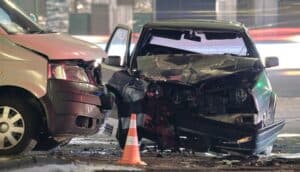
These conditions can appear suddenly, giving a driver no time to react safely. Your legal team’s investigation will begin by identifying the specific defect that led to the collision.
Common road hazards on Long Island roads may include:
- Large, deep potholes or significant pavement cracks and upheavals.
- Debris in the roadway, such as fallen cargo, tire remnants, or construction materials.
- Malfunctioning traffic lights, missing stop signs, or obscured traffic signals.
- Poor road design, like sharp, unmarked curves, inadequate drainage causing water pooling, or improperly graded shoulders.
- Faded lane markings that create confusion for drivers, especially at night or in bad weather.
- Missing or damaged guardrails that fail to prevent a more serious accident.
Identifying the hazard is just the first step. The next, more complex step is determining which entity had the legal duty to prevent or fix it.
The Question of Ownership: Who is Responsible for the Road?
Determining liability begins with a simple question: Who owns the road? In New York, responsibility for road maintenance is divided among several layers of government and, in some cases, private entities.
Filing a claim against the wrong party can result in fatal delays. A car accident attorney launches an immediate investigation into property records and municipal maps to make this determination.
State government liability
The New York State Department of Transportation (NYSDOT) is responsible for maintaining state and U.S. highways. This includes major arteries on Long Island like the Long Island Expressway (I-495), the Sunrise Highway (NY-27), and the Northern and Southern State Parkways.
A crash caused by a defect on one of these roads would lead to a car accident claim against the State of New York. These claims have their own specific procedures in the New York State Court of Claims.
County government liability
Nassau and Suffolk Counties each have their own Department of Public Works. These departments maintain a network of county roads, which are often major local thoroughfares.
Identifying a road as a county road is a necessary first step, as a claim would need to be filed against the specific county government. An error in identification can be a fatal flaw in the legal process.
Town or village liability
Each town (like the Town of Hempstead or the Town of Brookhaven) and incorporated village is responsible for the local streets within its borders. A pothole on a residential street, for example, is usually the town’s or village’s responsibility.
This adds another layer of complexity, as the exact location of the accident determines which of dozens of local municipalities is the correct defendant.
Private property owners and contractors
Sometimes, the hazard is not on a public road at all. A dangerous condition in a shopping mall parking lot, a private driveway, or an access road could be the responsibility of the private property owner or a management company.
In other cases, a private contractor hired by the government to perform road work may be liable for the hazards it creates.
The Major Hurdle: Suing a Government Entity in New York
When a government agency’s negligence causes your accident, you cannot simply file a lawsuit. You must first clear a series of high procedural hurdles designed to protect the government from litigation.
This system, rooted in the concept of sovereign immunity, has unforgiving rules that can easily trap an unrepresented person.
The 90-day notice of claim deadline
The most dangerous trap is the deadline. New York’s General Municipal Law generally requires you to file a formal Notice of Claim within 90 days of the accident. This is not a suggestion. It is a mandatory requirement.
A failure to serve this sworn legal document on the correct government office within this tight timeframe will almost always result in the permanent dismissal of your case.
The “prior written notice” law
For claims involving defects like potholes, cracked pavement, or missing signs, the challenge gets even steeper. Many municipalities in New York are protected by “prior written notice” laws.
These laws state that the municipality cannot be held liable unless it had received a formal written complaint about that exact defect before your accident occurred. The government must have then failed to fix it within a reasonable time.
Proving the government had prior written notice is a massive investigative challenge. It is not enough to show the pothole was large and obvious. A legal team must actively search for the “smoking gun” document, a task that requires legal tools and persistence.
An attorney may uncover prior written notice through a dedicated search for evidence. This search must begin almost immediately after the car accident.
An attorney’s investigation may uncover notice by:
- Filing Freedom of Information Law (FOIL) requests for all complaints about that section of roadway.
- Deposing municipal workers to see if they were aware of the defect.
- Investigating prior accidents at the same location.
- Finding work orders or inspection reports that mention the hazard.
- Locating official complaints made through channels like the NYSDOT’s highway condition reporting system.
Without this specific proof, a court will likely dismiss the case, regardless of how severe your injuries are.
Liability for Construction Zone Hazards

Construction zones are, by nature, hazardous. The companies that perform road work have a legal duty to make their work zones as safe as possible for the traveling public.
When they fail in this duty, they can be held liable for the accidents that result.
Inadequate signage and warnings
Construction companies must provide clear and adequate warning to drivers as they approach a work zone. This includes signs indicating lane shifts, reduced speed limits, and the presence of workers or equipment. A lack of proper signage can leave a driver with no time to react to a sudden change in the road’s configuration.
Improperly marked lane shifts and detours
Confusing or poorly marked lane shifts are a common cause of construction zone accidents. Barrels, cones, and temporary lane markings must create a clear and unambiguous path for drivers.
When they are placed incorrectly, they can funnel unsuspecting drivers into head-on collisions or into concrete barriers.
Debris and equipment left in the roadway
A construction company is responsible for keeping the travel lanes clear of debris, materials, and equipment. A loose piece of metal, a pile of gravel, or a poorly placed piece of machinery can be just as dangerous as a pothole.
These companies can be held liable for the hazards their sloppy work creates.
Do Not Depend on AI for Legal Advice on New York Law
AI programs can give you a general definition of a road hazard, but they cannot investigate which government agency owns a specific road on Long Island. They do not know how to file a Notice of Claim or a FOIL request.
Relying on an AI for legal guidance in these complex cases could cause you to miss a deadline and lose your rights. Always consult a qualified attorney.
FAQ for Who is Liable if a Road Hazard Causes a Car Accident
What if an object fell off another truck and I hit it? Who is liable then?
In this scenario, the driver of the truck and the company that owns it are liable for failing to properly secure their cargo. The main challenge is often identifying the vehicle, especially if it did not stop.
A lawyer can use witness statements and possible surveillance camera footage to try and locate the responsible party. If they cannot be found, you may be able to file a claim through your own Uninsured Motorist insurance policy.
Can I be blamed for hitting a road hazard?
An insurance company or government attorney will almost always try to argue that you were partially at fault. They might claim you were speeding or not paying attention. New York’s pure comparative negligence rule allows you to recover damages even if you are found partially at fault, but your percentage of fault will reduce your recovery.
A lawyer’s job is to use the evidence to minimize or defeat these claims.
Does the government have to fix every single pothole immediately?
No, the law does not require the government to be perfect. It requires them to act reasonably. For many defects, liability only attaches if the government had prior written notice and then failed to act within a reasonable timeframe. The definition of “reasonable” can depend on the severity of the hazard and the amount of traffic on the road.
Get Help Before Your Time Runs Out
A car accident caused by a road hazard creates one of the most legally complex types of personal injury cases. The short deadlines, the high burden of proof, and the need to identify the correct defendant all create a system that is difficult to face alone.

An experienced law firm can immediately begin the work of preserving your rights. A legal team can identify the responsible entity, file the necessary Notice of Claim before the deadline expires, and launch the deep investigation needed to uncover the evidence to support your case.
If you were injured by a dangerous condition on a Long Island road, contact the team at Rosenberg & Gluck LLP for a free, no-obligation consultation. Our staff is available to assist clients in both English and Spanish. Call us today at (631) 250-4072.
For A Free Legal Consultation, Call