The rise of Uber and similar rideshare services has revolutionized transportation across New York State. This convenience, however, has layered profound nuance onto the consequences of any car accident.
When an Uber or Lyft vehicle is involved, the critical question is no longer just, "Who was at fault?" but "What was the driver's status on the app at the precise moment of the crash?"
The answer to that question determines which insurance policy applies, the driver's small personal policy or a commercial policy provided by the rideshare company with limits that can exceed $1 million. Accessing that larger policy is often the difference between adequate compensation and a devastating financial loss for the victim.
At Rosenberg & Gluck, LLP, we are skilled at cutting through the legal noise. We break down the tiered liability structure for rideshare accidents in New York State, explaining when and how Uber is liable for your injuries, and why securing the right evidence immediately is paramount.
Call (631) 451-7900 to discuss your case with us.
Key Takeaways
- App Status is Everything: Uber's liability hinges on the driver's status: App Off (no Uber coverage), App On/Waiting (low-limit coverage of $75k/$150k), or On-Trip (high-limit commercial coverage of $1.25 Million+).
- The $1.25 Million Target: For serious injuries, the goal is to prove the driver was either en route to a passenger or had a passenger onboard to access the large commercial policy.
- Independent Contractor Defense: Uber is generally shielded from direct liability due to classifying drivers as independent contractors, but the claim is filed against the driver and the high-limit insurance policy Uber maintains.
- Evidence is Crucial: You must quickly secure digital evidence to lock in the driver's status, which an attorney must do via a Spoliation Letter to Uber.
- The No-Fault Hurdle: In New York, you must prove a "Serious Injury" to sue for pain and suffering and fully access the remuneration of the $1.25 million policy.
| Uber Driver App Status | Legal Period | Applicable Insurance Coverage | Policy Limits | What This Means for Victims |
| App Off (Personal Use) | Period 0 | Driver’s personal auto insurance only | Typically $25,000 / $50,000 | Very limited coverage. Serious injuries often exceed policy limits, leaving victims undercompensated. |
| App On, Waiting for Ride | Period 1 | Uber contingent commercial liability (secondary) | $75,000 per person / $150,000 per accident / $25,000 property damage | Coverage applies only if personal insurer denies the claim. Still insufficient for severe injuries. |
| En Route to Passenger | Period 2 | Uber primary commercial liability policy | $1.25 million combined | High-limit coverage becomes available. Proving this status is critical for full compensation. |
| Passenger Onboard | Period 3 | Uber primary commercial liability + SUM coverage | $1.25 million liability + $1.25 million SUM | Maximum protection. Covers catastrophic injuries and uninsured/underinsured driver scenarios. |
The TNC Act: New York’s Rideshare Insurance Tiers
In New York, Transportation Network Companies (TNCs) like Uber and Lyft are regulated by Article 44-B of the Vehicle and Traffic Law (VTL), which mandates specific insurance coverage tiers based on the driver's activity. The law recognizes three main "Periods" of engagement that dictate liability.
Period 0: App Off / Personal Use
- Driver Status: The Uber app is completely off. The driver is using the vehicle for personal errands, commuting, or other non-work-related activity.
- Uber's Liability: None. Uber provides no coverage in this period.
- Applicable Policy: Only the driver's personal auto insurance policy applies.
- The Risk: Most personal policies have the state minimum liability limits (e.g., $25,000 per person/$50,000 per accident). If your injuries are serious, this minimal coverage will be quickly exhausted, potentially leaving you with significant out-of-pocket expenses.
- The Legal Fight: If the accident occurs in Period 0, the claim proceeds like any car accident lawsuit against the at-fault driver.
Period 1: App On / Waiting for a Request
- Driver Status: The driver is logged into the Uber app and waiting to accept a ride request but has not yet received or accepted one.
- Uber's Liability: Limited. Uber's commercial liability coverage kicks in, but at a modest, secondary level.
- Applicable Policy: Uber provides contingent (secondary) third-party liability coverage of:
- $75,000 for bodily injury or death of one person.
- $150,000 for bodily injury or death of two or more people per accident.
- $25,000 for property damage.
- The Nuance: The driver's personal insurance policy is technically primary in this period, but since most personal policies have exclusions for commercial use, Uber's coverage often becomes the effective primary policy in practice if the personal insurer denies the claim.
- The Legal Fight: The immediate goal for your attorney is to prove the driver was logged into the app. While the limits are higher than a minimum personal policy, they are still relatively low for severe injuries.
Period 2 & 3: En Route to Pickup or Passenger Onboard
- Driver Status:
Period 2: The driver has accepted a ride request and is en route to the passenger. Period 3: The passenger is in the vehicle, and the ride is in progress.
- Uber's Liability: Full commercial liability. This is the highest tier of coverage and the most robust protection for victims.
- Applicable Policy: Uber provides a mandatory commercial liability policy of $1.25 Million for bodily injury, death, and property damage combined. This policy is primary and is triggered regardless of whether the driver’s personal policy covers commercial driving.
- The Goal: For any serious injury, a victim must aim to prove the driver was in this period. Accessing the $1.25 million policy provides the necessary financial foundation to cover catastrophic medical bills, long-term care, and significant pain and suffering.
- Crucial Add-On: This policy also includes $1.25 million in Supplemental Uninsured/Underinsured Motorist (SUM) coverage, which protects Uber passengers if the other car involved in the collision is uninsured or has very low limits.
New York City Exception: TLC Regulation
New York City operates under slightly different regulations. Vehicles picking up passengers within the five boroughs are governed by the NYC Taxi and Limousine Commission (TLC). These vehicles are required to maintain a commercial insurance policy that is always in effect, typically with $1 million or more in liability coverage.
What This Means for Long Island: If your accident occurred on Long Island, the state TNC tiers (Periods 1, 2, and 3) apply, with the $1.25 million policy for an active trip. If you were injured in the City, the $1 million TLC-mandated commercial policy is generally in effect. An experienced New York attorney must understand this jurisdictional difference.
The Independent Contractor Loophole
Uber classifies its drivers as independent contractors, not employees. This distinction is the company's primary defense against direct liability claims.
The General Rule: No Vicarious Liability
In a traditional employment relationship, an employer is usually responsible for the negligent acts of an employee (a doctrine called respondeat superior). Because Uber drivers are contractors, Uber argues that it cannot be held directly liable for a driver's negligence.
The Exception: Suing Uber Directly
While most lawsuits target the driver's insurance policy (which is provided by Uber's commercial carrier), there are limited circumstances where you can sue Uber/Lyft directly for their own negligence:
- Negligent Hiring/Retention: If Uber knew or should have known a driver had a history of unsafe driving and failed to remove them from the platform.
- Product Liability/App Negligence: If the app's design or functionality encourages or distracts the driver to the point of negligence (e.g., constant pings or overly complex in-app navigation).
In the overwhelming majority of cases, your attorney will file a claim against the driver and the high-limit commercial insurance policy Uber maintains. The goal is to maximize your recovery from where possible.
New York's No-Fault Law: Your PIP and the Rideshare Claim
New York is a "No-Fault" state. This means your initial medical expenses and lost wages are typically covered by Personal Injury Protection (PIP) insurance, regardless of who was at fault.
Who Pays the PIP?
- If you are a passenger in the Uber: Uber's commercial insurance policy provides the PIP coverage (usually $50,000), covering your initial economic losses.
- If you are a driver/passenger in another vehicle: Your own vehicle's PIP policy pays first.
- If you are a pedestrian/cyclist: The Uber vehicle's PIP policy pays first if the Uber driver was at fault.
Stepping Outside of No-Fault
PIP only pays for economic losses (medical bills, lost wages). To sue the at-fault driver for non-economic damages (pain and suffering), you must prove you sustained a "Serious Injury" as defined by New York Insurance Law § 5102(d).
For severe injuries resulting from an Uber accident, meeting this threshold is often straightforward, allowing us to fight for access to the full value of the $1.25 million liability policy for your damages.
The Critical Evidence: Proving the Driver's Status
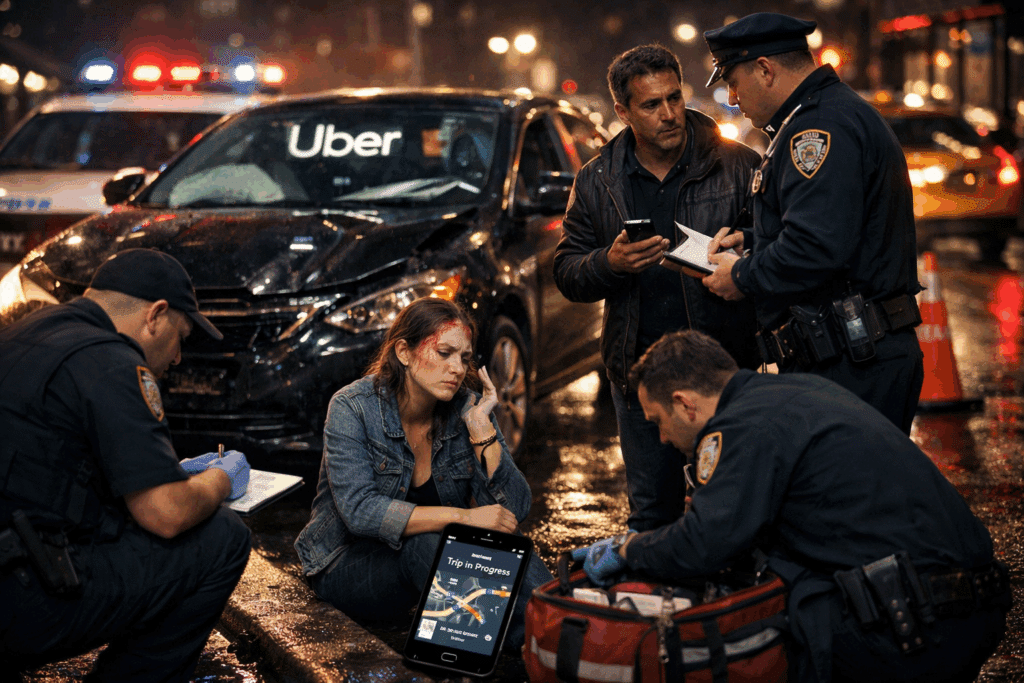
Insurance companies will vigorously fight to place the driver into the lowest possible liability tier (Period 0 or Period 1) to minimize their payout. Proving the driver was in Period 2 or 3 requires immediate and aggressive action.
1. The Digital Trail
This is the most crucial piece of evidence. Uber/Lyft have detailed GPS and app logs that track the driver's movements, log-in/log-out times, and the exact moment a trip request was accepted. Your attorney must immediately issue a Spoliation Letter to Uber, legally demanding the preservation of these logs before they can be purged.
2. Passenger Documentation (The Screenshot)
If you were a passenger, the screenshot of your receipt, the driver's name, the car's license plate, and the trip details on the app are invaluable. This evidence unequivocally places the accident in Period 3.
3. Police and Witness Reports
The police report (MV-104) may contain a narrative that indicates the driver was "going to pick someone up" or "had just dropped off a fare," helping to establish a connection to the app. Eyewitnesses may confirm the driver was holding a phone or glancing at the app before the collision.
Varying Liability
Uber's liability framework changes depending on your role in the crash:
| Your Role | Who Pays the PIP (Initial Expenses) | Who to Sue for Pain & Suffering (Liability) | Policy Target |
| Uber Passenger | Uber's Commercial PIP ($50,000) | The Uber driver, or the driver of the other vehicle. | Uber's $1.25M Policy (Primary) |
| Driver of Another Car | Your own PIP ($50,000) | The Uber driver (if at fault). | Uber's $1.25M Policy (Primary) |
| Pedestrian/Cyclist | Uber's Commercial PIP ($50,000) | The Uber driver (if at fault). | Uber's $1.25M Policy (Primary) |
Vital Note: The high-limit $1.25M policy applies only if the Uber driver was in Period 2 or 3.
Why You Cannot Fight Uber Alone
Dealing with Uber or Lyft's commercial insurance carriers is a legal battle. These entities are sophisticated, highly motivated to deny that their high-limit policy applies, and they employ teams of lawyers trained to exploit procedural mistakes.
- Challenging the Status: They will automatically try to claim the driver was in Period 1 (low limit) or Period 0 (no liability) until you provide incontrovertible evidence otherwise.
- Proving Serious Injury: Even with the high-limit policy, you still need an attorney to gather medical evidence and expert testimony to prove your injuries meet the "serious injury" threshold required to collect damages for pain and suffering.
- Comparative Negligence: New York follows a pure comparative negligence rule. If an insurer can argue you were partially at fault (e.g., 20%), they will reduce your award by that percentage. Your lawyer's job is to protect your percentage of recovery.
Your Next Steps After an Uber Accident
If you or a loved one has been injured in a collision involving an Uber or Lyft vehicle in Long Island or New York, the time to act is now.
- Get Medical Attention: Your health is the absolute priority. Do not delay, as gaps in treatment can hurt your case.
- Call the Police: Get an official accident report.
- Gather Evidence: Take photos of all vehicles, the Uber app screen (if possible), and the license plates. Get contact info from the driver and any witnesses.
- Do Not Speak to Insurers: Do not give a recorded statement or sign anything without consulting an attorney.
- Contact Rosenberg & Gluck, LLP: We will handle the process of obtaining Uber's internal log data and fighting to secure the highest available insurance policy limits to cover your medical expenses, lost wages, and pain and suffering.
We are ready to fight for you and hold negligent rideshare drivers accountable. You pay no fee unless we win your case.
Call us today at (631) 451-7900 for a free, confidential consultation.