In most New York chain-reaction accidents, the driver who hit you from behind is considered liable for the damage to all vehicles involved. However, this straightforward rule doesn’t stop the at-fault driver's insurance company from trying to shift the blame onto you. They might argue that you stopped suddenly or followed the car ahead too closely, complicating your claim and putting your right to fair compensation at risk.
Proving what really happened requires understanding the critical evidence—from witness accounts to the specifics of state traffic laws—that can definitively establish liability and protect your financial future.
Call us today at (631) 451-7900 for your free consultation.
Key Takeaways about Liability in Rear-End Accidents
- In most New York-based chain-reaction accidents, the driver who initiates the rear-end collision is typically found liable for the damages to all vehicles involved.
- The sequence of impacts is the most critical factor in determining fault; establishing that the rear impact occurred first is essential.
- Event Data Recorders (EDRs), also known as "black boxes," can provide objective data like speed and braking to prove a driver was stopped before being pushed.
- New York's pure comparative negligence rule allows a person to recover damages even if they are found partially at fault for the accident.
- Injuries from "sandwich" collisions can be particularly severe due to the double impact, often leading to complex spinal conditions.
Understanding the Chain Reaction: The Sequence of Impacts Is Everything
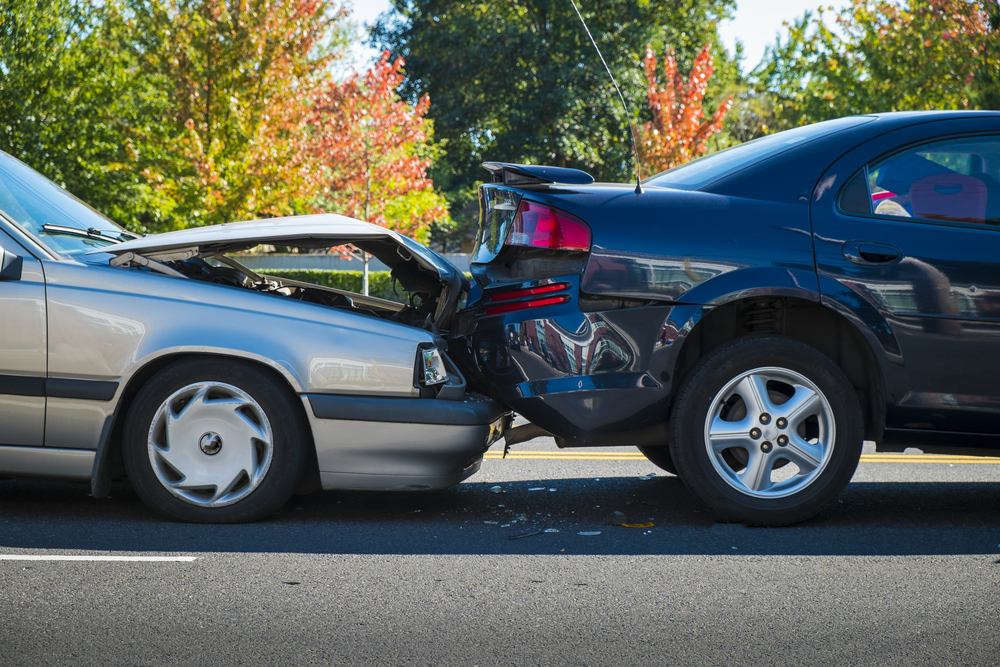
When determining who is at fault in a multi-car accident, the single most important factor is the sequence of the collisions. Insurance adjusters will scrutinize the details to see if they can shift blame away from their client. The entire case often comes down to one of two scenarios.
Scenario 1: You Were Pushed
This is the most common situation in a three-car "sandwich" collision.
- Car #1 is stopped.
- Car #2 (your vehicle) is stopped safely behind Car #1 or coming to a safe stop behind Car #1.
- Car #3 fails to slow or stop timely and collides with the rear of your vehicle.
- The force of this impact propels your vehicle forward, causing it to hit Car #1.
In this scenario, the driver of Car #3 is almost always considered 100% at fault. Their initial negligence—failing to maintain a safe following distance or stop in time—was the direct cause of both subsequent impacts. The driver of Car #1 and you, the driver of Car #2, are typically able to file claims against the insurance policy of the driver of Car #3.
Scenario 2: You Hit First
The insurance company for the rear driver will often try to argue that a different sequence of events occurred.
- Car #1 is stopped.
- Car #2 (your vehicle) fails to stop in time and rear-ends Car #1.
- Car #3 then rear-ends your vehicle a moment later.
If this is what happened, liability becomes more complicated. You could be held partially responsible for the damage to the front of your car and the rear of Car #1. The driver of Car #3 would only be responsible for the damage to the rear of your vehicle and any injuries resulting from that second impact.
Insurance adjusters favor this version because it can significantly reduce their company’s financial responsibility. This is why proving the true sequence of events is so important.
Using Investigation and also Modern Technology to Prove Your Case
How can you fight back when the other driver falsely claims you stopped short or hit the car in front of you first? Witness testimony and police reports can be helpful. However, they can also be subjective. Today, many modern vehicles contain equipment that permits real-time recording of an accident. This could be video recording or recording by the Event Data Recorder (EDR), often called a "black box."
An EDR is a small device in your vehicle that records technical information for a few seconds before, during, and after a crash. Accessing this data can provide a clear, unbiased picture of what really happened on the road.
In some situations, it may be necessary to try to retrieve and analyze EDR data, which often includes:
- Vehicle Speed: The EDR can show if your vehicle was completely stopped (0 mph) at the moment of the rear impact.
- Brake Application: It records whether your foot was on the brake, proving you were attempting to remain stationary.
- Steering Input: This shows the direction your wheels were turned.
- Force of Impact: The data can measure the severity of the collision from behind.
This information is powerful. It can definitively refute a false claim that you caused the initial collision by "stopping short" or "following too closely." If your vehicle's EDR shows you were at a complete stop when the collision occurred, it becomes very difficult for an insurance company to argue that you share any blame for the crash. Video of the crash can also definitively establish the sequence. Some cars today record video, and this may be retrievable, showing the moments leading up to a crash.
The "Sandwich" Injury Factor: Why These Crashes Cause Serious Harm

Being "sandwiched" between two vehicles is not just a figure of speech; it describes a physically devastating event. Your body is subjected to two distinct and powerful impacts in rapid succession. First, the rear impact violently throws you back against your seat. A split second later, the secondary impact with the car in front of you sends your body whipping forward.
This double-impact dynamic places immense and complex forces on the spine, particularly the neck (cervical spine) and lower back (lumbar spine). It can cause injuries that are far more severe than those from a typical single-impact collision.
Common injuries sustained in chain-reaction accidents include:
- Herniated or Bulging Discs: The powerful opposing forces can cause the soft, gel-like discs that cushion your vertebrae to rupture or shift out of place, putting pressure on spinal nerves and causing excruciating pain, numbness, or weakness.
- Traumatic Brain Injuries (TBIs): The violent snapping of the head back and forth can cause the brain to strike the inside of the skull, leading to concussions or more severe brain injuries with long-term cognitive effects.
- Severe Whiplash: While common in many rear-end collisions, whiplash in a sandwich crash can involve extensive damage to the muscles, ligaments, and tendons in the neck.
- Spinal Cord Injuries: In the most serious cases, the forces involved can fracture vertebrae and lead to damage to the spinal cord itself, resulting in partial or full paralysis.
These types of injuries are often not immediately obvious at the scene of the accident. The adrenaline of the crash can mask pain for hours or even days. That is why seeking a thorough medical evaluation is critical. These conditions frequently require extensive treatment, such as physical therapy, pain management injections, or even surgery, and the associated costs can be substantial.
What Happens if They Say I Was Following Too Closely?
One of the most common defense tactics used by an at-fault driver's insurance company is to claim you were partially responsible for the accident by "following too closely." They will cite New York Vehicle & Traffic Law § 1129, which states that a driver "shall not follow another vehicle more closely than is reasonable and prudent."
Their goal is to invoke a legal principle known as comparative negligence. In some states, if you are found even 1% at fault, you are barred from recovering any compensation. New York is different. The state follows a pure comparative negligence rule.
Pure comparative negligence means that you can still recover damages even if you are found to be partially at fault. However, the amount of your financial recovery will be reduced by your assigned percentage of fault.
For example, imagine you are in a chain-reaction crash on the Sunrise Highway. A court determines that the driver who hit you from behind was 90% at fault, but that you were 10% at fault for following the car in front of you a little too closely. If your total damages (medical bills, lost wages, pain and suffering) are calculated to be $200,000, you would be able to recover $180,000 (your total damages minus your 10% of fault).
While this rule is fairer than in many other states, it is crucial to fight any attempt to assign you undeserved blame. Every percentage point of fault an insurance company can place on you is money they do not have to pay. A car accident attorney can use evidence like EDR data, surveillance camera footage, and witness statements to build a strong case that the rear driver was solely responsible for the collision.
Steps to Take After a Multi-Car Accident in Long Island

After the initial shock of the accident has passed, the steps you take can significantly impact your ability to receive fair compensation for your injuries and property damage. Here is what you should focus on.
- Get a Full Medical Evaluation: Even if you feel only minor aches and pains, it is essential to see a doctor. Some serious injuries, like herniated discs or concussions, have delayed symptoms. A medical visit creates an official record that connects your injuries to the accident.
- Organize Your Documents: Keep all paperwork related to the accident in one place. This includes the police report, the driver information you exchanged at the scene, photos you took of the vehicles and location, and any correspondence you receive from insurance companies.
- Report the Crash to Your Insurance Company: You are obligated to notify your own insurance carrier about the accident. Provide them with the basic facts of what happened, but it is wise to decline to give a recorded statement until you have had the opportunity to speak with an attorney.
- Be Careful When Speaking to Other Insurers: The insurance adjuster for the at-fault driver will likely contact you very soon after the crash. Remember, their job is to protect their company's financial interests, not yours. They may ask leading questions designed to get you to admit partial fault. Be polite but firm, and do not agree to a recorded statement or accept a quick settlement offer.
Taking these measured steps helps protect your rights while you consider your next course of action.
Rear-End Accident Liability FAQs
Here are answers to some common questions that arise after a multi-car collision.
What if the driver who caused the accident was uninsured?
If the at-fault driver has no insurance, you may still be able to recover compensation through the Uninsured Motorist (UM) coverage on your own auto insurance policy. This is a mandatory coverage in New York designed to protect you in exactly this type of situation.
How long do I have to file a personal injury claim in New York?
In New York, the statute of limitations—the legal deadline for filing a lawsuit—for most personal injury claims from a car accident is three years from the date of the crash. However, there are important exceptions. For instance, if your claim is against a municipality (like a town or county vehicle), you typically must file a notice of claim within 90 days.
What is a "sudden stop" defense, and how is it challenged?
A "sudden stop" defense is when the rear driver claims the driver in front of them slammed on their brakes unexpectedly and without cause, making the collision unavoidable. This defense can be challenged with evidence from the vehicle's EDR (showing you were already stopped), traffic camera footage, or witness testimony that proves you came to a safe, controlled stop due to traffic conditions ahead.
Does New York’s No-Fault insurance cover my medical bills initially?
Yes. New York is a No-Fault state, which means your own auto insurance policy's Personal Injury Protection (PIP) coverage is the primary source of payment for your initial medical bills and a portion of lost wages, regardless of who was at fault. However, for serious injuries that exceed these basic benefits, you must file a claim against the at-fault driver to recover full compensation.
How a Personal Injury Attorney Can Help Your Case
When you are recovering from injuries sustained in a multi-car collision, the last thing you should have to do is battle with insurance companies. An attorney focused on personal injury law can handle every aspect of your claim, allowing you to focus on your health.
The legal team at Rosenberg & Gluck, LLP understands the complexities of chain-reaction accidents on Long Island. We conduct thorough investigations to establish the true sequence of events, gathering crucial evidence like police reports, witness statements, video, and possibly EDR data to build a solid case on your behalf. We will handle all communications with insurance adjusters, protecting you from tactics designed to devalue your claim.
Our attorneys are experienced in calculating the full and fair value of a claim, including future medical needs, lost income, and the significant impact a serious injury has on your life. If you have been injured in a multi-car accident, you do not have to face the process alone. Contact Rosenberg & Gluck, LLP for a free, no-obligation consultation to discuss your case. We are ready to help in both English and Spanish.
Call us today at (631) 451-7900 for your free consultation.