
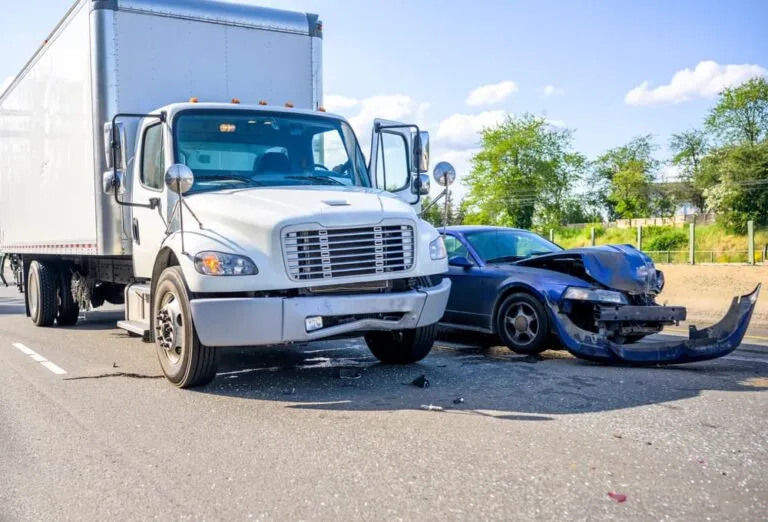

A truck accident leaves behind more than physical injuries. Medical bills pile up, paychecks stop coming, and the pain of losing someone you love doesn’t have a deadline. If you or a family member suffered serious harm because of a truck accident on Long Island that someone else caused, Rosenberg & Gluck, LLP is here to help.
Our Long Island truck accident lawyer team handles these cases with care, determination, and a deep understanding of how New York law applies to your situation. Call us today at (631) 250-4072 for a free consultation.
Click to contact our Long Island Personal Injury Lawyers today.
Why Do Truck Accident Cases Differ from Car Accident Cases?
Truck accident claims follow different legal rules than standard car accident cases, and the difference matters for your recovery. Commercial trucks operate under federal and state regulations that don’t apply to ordinary drivers. When those rules are broken, multiple parties may share responsibility for what happened to you.
Multiple Liable Parties
In a typical car accident, you’re usually dealing with one driver and one insurance company. A truck accident can involve the truck driver, the trucking company, a cargo loading crew, a vehicle maintenance contractor, or even a truck manufacturer.
Each of those parties may carry separate insurance policies, and each may try to shift blame to another. Sorting through that web of liability requires someone who knows how these cases work.
Federal Regulations
Federal regulations from the Federal Motor Carrier Safety Administration (FMCSA) govern how long truckers can drive without rest, how cargo must be secured, and how vehicles must be maintained.
When a driver logs too many hours or a company skips required inspections, the evidence of that violation can support your claim. We know where to look for that evidence and how to use it.
What Causes Truck Accidents on Long Island?
Several factors consistently contribute to serious crashes.
Driver Fatigue
Driver fatigue tops the list. Federal rules limit how many hours a trucker can drive, but those limits get pushed. A tired driver traveling at highway speeds can cause catastrophic harm before ever hitting the brakes.
Distracted Driving
Distracted driving, impaired driving, and inadequate training also appear frequently in the investigation files of serious truck accidents.
Mechanical Failure and Lack of Maintenance
Equipment failure is another major factor. Brake failures, tire blowouts, and steering defects can turn a routine delivery route into a tragedy. When a trucking company defers maintenance to cut costs, or a manufacturer ships a defective part, those choices put every driver around them at risk.
Cargo Loading Issues
Improper loading causes accidents too. An unsecured or overweight load shifts during a turn or emergency stop and the driver loses control. On roads like Sunrise Highway or near the commercial corridors in Bethpage, where traffic moves fast and lane changes happen often, that kind of accident can involve multiple vehicles.
Who Can Be Held Responsible After a Truck Accident?
Depending on the circumstances of your accident, responsible parties may include:
- The truck driver, if recklessness, fatigue, or impairment contributed to the crash
- The trucking company, if poor hiring practices, inadequate training, or pressure to violate safety rules played a role
- A cargo company, if improperly loaded or secured freight caused the truck to lose control
- A maintenance provider, if defective repairs or skipped inspections contributed to equipment failure
- A vehicle or parts manufacturer, if a defective component caused or worsened the accident
Identifying who bears legal responsibility for your injuries is one of the most important parts of a truck accident claim, and it isn’t always obvious from the scene. Our attorneys look at the evidence to determine all parties who may bear liability for your injuries, and we pursue damages aggressively.
How New York’s Comparative Fault Affects Your Claim
New York follows a rule called pure comparative negligence. That means even if you were partially at fault, you can still recover compensation. Your award is simply reduced by your percentage of fault.
If a jury finds you 20 percent responsible, you recover 80 percent of your total damages. We work to protect your share of recovery at every step.
What Compensation Can You Pursue After a Long Island Truck Accident?
In a NY truck accident claim, you may have grounds to seek compensation for:
- Current and future medical expenses, including surgery, rehabilitation, and any ongoing treatment
- Lost wages from time you couldn’t work during recovery
- Reduced earning capacity if your injuries affect your ability to work long-term
- Pain, suffering, and emotional distress
- Loss of enjoyment of life, if your injuries have changed what you’re able to do day to day
- Wrongful death damages if your family lost a loved one in the accident, including funeral expenses and loss of financial support
New York law requires that truck accident injury victims pursue claims through the at-fault party’s insurance rather than your own personal injury protection (PIP) coverage, which applies to car accidents.
Serious injury threshold rules in New York define the level of injury required to pursue certain damages. We’ll explain exactly how those rules apply to your situation from the first call.
Why You Need a Lawyer for a Truck Accident Claim
Trucking companies have insurers and legal teams who often begin investigating within hours, sometimes sending representatives to the scene before the injured party has even left the hospital. That early work serves one purpose: protecting the company’s financial interests.
The Insurance Company Is Not on Your Side
Without legal representation, you’re at a significant disadvantage. Trucking companies have teams of lawyers whose job is to minimize what they pay out. They may ask you to give a recorded statement or request that you sign broad medical authorization forms
Responding to a Quick Settlement
They may offer a quick settlement that doesn’t come close to covering your actual losses. Accepting that offer closes your right to seek more.
Preserving Evidence That Supports Your Claim
Our skilled truck accident lawyers on Long Island preserve the evidence that matters. Electronic logging device data, black box recordings, driver history, maintenance records, and dashcam footage can all be lost or destroyed if no one acts quickly to preserve them. We send legal holds as soon as we take your case.
Handling the Insurance Companies
We also handle all communication with the insurance companies so you don’t have to. You focus on recovering. We focus on building the strongest possible claim on your behalf.
How Our Firm Handles Long Island Truck Accident Cases
Rosenberg & Gluck, LLP has spent years representing injured people across Long Island in serious personal injury matters, including truck accident claims. We understand the local courts, the procedures in Suffolk and Nassau County, and how these cases typically unfold from investigation through resolution.
We Build Your Case from the Ground Up
From the start, we work to gather every piece of evidence that supports your claim. We work with accident reconstruction professionals, review all available records, and identify every party whose conduct contributed to your injuries. We don’t guess. We build.
Our Approach Puts You First
Our approach is client-first. We know that the months following a serious truck accident are hard on your whole family, not just physically but in every dimension of daily life. You deserve honest answers about what your case is worth, a realistic timeline for resolution, and a legal team that keeps you informed every step of the way.
No Fees Unless We Obtain Compensation
We handle truck accident cases on contingency. That means you pay nothing unless we recover compensation for you. There are no upfront fees and no hourly charges. Your ability to pursue justice doesn’t depend on your ability to pay legal fees right now.
If you’ve been hurt in a truck accident near Commack, Melville, or anywhere else across Long Island, call us at (631) 250-4072.. We’ll review your case at no cost and give you a clear picture of your options.
How Long Do You Have to File a Truck Accident Lawsuit in New York?
New York’s statute of limitations for personal injury claims is generally three years from the date of the accident. If you miss that deadline, courts will typically refuse to hear your case, regardless of how strong it is.
Wrongful death claims carry a shorter deadline of two years from the date of death.
Claims Against Government-Owned Trucks
Claims involving government-owned vehicles or government employees require a notice of claim filed within 90 days of the accident, followed by specific procedural steps. Missing any of these deadlines eliminates your right to recover.
Act Quickly to Protect Your Rights
Regardless of the deadline that applies to your case, you need to begin the process as soon as possible. Evidence fades. Witnesses become harder to reach.
Trucking companies have retention policies that may result in the deletion of key records if no legal hold exists. Starting your claim promptly protects the evidence and your rights.
What Should You Do After a Truck Accident on Long Island?
The steps you take after a truck accident shape the outcome of your claim. If you can, take the following actions:
- Seek medical care right away, whether that’s Southside Hospital in Bay Shore, Good Samaritan Hospital Medical Center in West Islip, or the nearest emergency facility
- Call law enforcement and make sure an official report gets filed
- Document everything you can at the scene with photos, witness names, and the truck driver’s information and carrier details
- Avoid giving any statements to insurance company representatives before speaking with a lawyer
- Contact Rosenberg & Gluck, LLP as soon as possible so we can begin preserving evidence
Your health comes first. But protecting your legal rights starts the moment the accident happens.
Truck Accident FAQs
What should I do after a truck accident?
After a truck accident, get medical care right away and call the police. If you can, photograph the truck, its USDOT number, the company name on the door, the trailer, and the accident scene. Collect witness information, file your no-fault application within 30 days, and avoid speaking with the trucking company’s insurance adjuster. Trucking companies often send investigators quickly, so it is important to contact a truck accident lawyer who can preserve evidence such as black box and logbook data.
Who is liable in a truck accident?
Several parties can be liable in a truck accident. The truck driver may be at fault for speeding, fatigue, or distraction. The trucking company can be liable for its driver’s mistakes and for poor hiring, training, or maintenance. Others can include the cargo loader, the truck or parts manufacturer, a maintenance shop, or the owner of the trailer. Identifying every responsible party matters because it can add more insurance coverage.
How much does a truck accident lawyer cost?
Most truck accident lawyers work on a contingency fee, so you pay nothing upfront and the fee is a percentage of the money recovered. If there is no recovery, there is no fee. In New York, court rules limit fees in personal injury cases, and one-third of the net recovery is standard. At Rosenberg & Gluck, the consultation is free and we work on a contingency so you pay no legal fee unless we recover for you.
How do I file a truck accident claim?
A truck accident claim starts with a no-fault application, which you must file within 30 days. Next, your lawyer sends notice to the trucking company and its insurer, demands that evidence be preserved, and investigates the crash. Once your medical treatment is clearer, your lawyer submits a demand for settlement. If the insurer will not pay a fair amount, the next step is a lawsuit, which generally must be filed within three years.
What is the average settlement for a semi-truck accident?
There is no reliable average settlement for a semi-truck accident, but these cases are often larger than car crash cases. Trucks cause more serious injuries, and interstate carriers meeting certain criteria must carry at least $750,000 in liability coverage, which is often more than a typical car policy. The value depends on your injuries, future medical care, lost earning capacity, pain and suffering, and the evidence of fault.
Why do I need a truck accident lawyer?
Truck accident claims are more complex than car accident claims. Trucking companies and their insurers act fast to protect themselves, and key evidence like electronic logging device data, maintenance records, and driver files can be lost or overwritten. A truck accident lawyer can preserve that evidence, find violations of federal safety rules, identify every liable party, and push back against low settlement offers. Further, there is no risk to you as you pay no up-front retainer or legal fee unless we win.
Who pays my medical bills after a truck accident?
In New York, your no-fault insurance pays your medical bills and lost wages first, up to $50,000, regardless of fault. You can then pursue the truck driver and trucking company for economic damages above the no-fault limit. If your injuries meet the serious injury threshold, you can also recover pain and suffering. Your health insurance can also cover treatment after no-fault benefits run out.
How are truck accidents different from car accidents?
Truck accidents are different from car accidents in size, rules, and liability. A loaded tractor-trailer can weigh up to 80,000 pounds, about 20 times more than a car, and needs much more distance to stop, so crashes tend to cause more serious injuries. Truck cases also involve federal safety regulations, such as hours-of-service rules, and higher insurance limits. Several parties may share liability, including the company, the shipper, and maintenance providers. This makes the investigation and the claim more involved than a car accident case.
How do truck accident lawsuits work?
A truck accident lawsuit starts with an investigation and a complaint filed in court, usually within three years in New York. Both sides then exchange evidence in discovery, which may include logbooks, black box data, maintenance records, and depositions of the driver and company staff. Many cases settle during this stage or in mediation. If they do not, the case goes to trial, where a jury decides fault and damages.
How long does a truck accident lawsuit take?
Most truck accident lawsuits take one to three years. Cases with clear fault and finished treatment can settle in less time, while cases with catastrophic injuries, several defendants, or disputes over fault can take longer. The court calendar also plays a role. A lawyer can keep the case moving by preserving evidence early and pressing for discovery deadlines.
Can I sue the trucking company, not just the driver?
Yes. In most cases, you can sue the trucking company as well as the driver. Under New York law, an employer is responsible for its employee’s negligence while on the job. Further, New York holds the owner of the truck responsible, with limited exceptions. The company may also be directly liable for poor hiring, training, supervision, or maintenance, or for pushing unrealistic schedules. Trucking companies usually carry much more insurance than individual drivers.
What is a truck ‘black box’ and how does it help my case?
A truck’s black box, or event data recorder, records speed, braking, throttle, and sometimes seatbelt and engine data in the moments before a crash. Electronic logging devices also record driving hours. This data can show whether the driver was speeding, braked late, or drove past federal hour limits. Some data can be overwritten quickly, so your lawyer should send a preservation letter as soon as possible.
What if the truck driver broke hours-of-service rules?
Federal hours-of-service rules limit truck drivers to 11 hours of driving after 10 hours off duty. Drivers also may not drive beyond the 14th consecutive hour after coming on duty, following 10 consecutive hours off duty. Further, a 30-minute break after 8 hours of cumulative driving is required. A driver who breaks these rules is more likely to be fatigued, and the violation can be strong evidence of negligence. The trucking company can also be liable if it encouraged or ignored the violations. Logbook and ELD data are key evidence.
What if the truck driver was an independent contractor?
You may still be able to hold the trucking company responsible. Federal rules treat a motor carrier as responsible for the trucks operating under its authority, and companies cannot always avoid liability by calling a driver an independent contractor. Courts look at who controlled the work, the truck, and the route. The driver’s own insurance and the carrier’s coverage may both be available.
What are the most common causes of truck accidents?
The most common causes of truck accidents include driver fatigue, speeding, distracted driving, following too closely, and unsafe lane changes. Other causes include brake failures and poor maintenance, overloaded or unbalanced cargo, inadequate training, and impaired driving. Wide turns and blind spots also lead to many crashes. Finding the cause helps show who is liable.
Contact Rosenberg & Gluck, LLP After a Long Island Truck Accident
Suffering serious injuries in a truck accident, or losing someone you love because of one, changes the course of your life in ways that deserve real accountability. Medical care, lost income, and the grief that follows don’t just resolve on their own. You need a legal team with the experience, knowledge, and dedication to fight for what you’re owed.
Rosenberg & Gluck, LLP represents injured people and grieving families throughout Long Island. We take on the trucking companies and their insurers, we fight for full and fair compensation, and we do it without charging you anything unless we win.
If you or someone in your family was hurt in a truck accident that someone else caused, don’t wait to get answers. Call (631) 250-4072 today for your free consultation with our Long Island truck accident lawyer team. We’re ready to listen, and we’re ready to help.
Call us today at (631) 250-4072 for your free, no-obligation consultation.

