
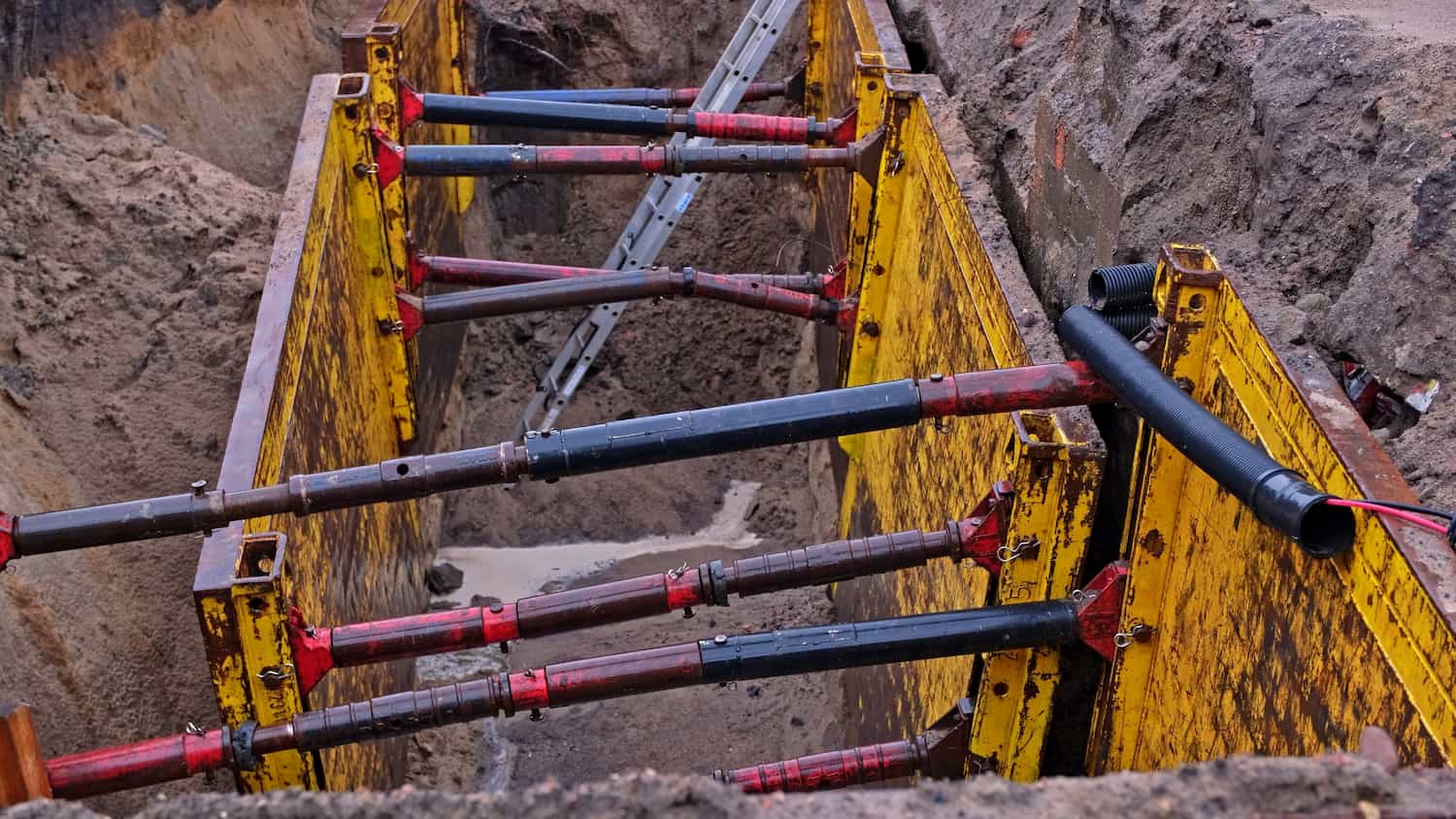
A trench collapse accident on Long Island can leave you or a family member facing severe injuries, time away from work, and tough questions about who is responsible. In many cases, your rights go beyond workers’ compensation, and you may be able to bring a separate claim against parties who failed to keep the excavation safe.
New York Labor Laws, including protections for gravity‑related and excavation work, can make site owners and general contractors legally accountable when they do not provide proper shoring, shielding, or other trench safety measures.
These third‑party claims can pursue compensation that workers’ comp does not fully cover, such as pain and suffering and full lost wages. Because trench work often involves layers of contractors, subcontractors, utilities, and property owners, figuring out liability is rarely simple.
A Long Island construction accident lawyer from Rosenberg & Gluck, LLP can investigate who controlled the work, which safety rules were violated, and whether you have a third‑party claim in addition to workers’ compensation. During a free case review you can learn how we use the following legal insights to fight for your rights and maximum recovery.
For A Free Legal Consultation, Call

Key Takeaways for Trench Collapse Liability
- Workers’ compensation may only be one potential avenue for compensation. While WC benefits cover medical bills, a third-party excavation injury lawsuit against a general contractor or property owner allows you to recover damages for pain and suffering and lost future wages.
- Property owners and general contractors have a non-delegable duty. They are liable for trench safety violations in NY, even if they hired a subcontractor to do the work or were not present when the collapse happened.
- Evidence disappears quickly after an accident. Partnering with a construction site accident lawyer on Long Island as soon as possible after the accident may help preserve the strong evidence needed to support your claim.

Who Is Liable for a Trench Collapse in New York?
New York law recognizes that construction workers have little control over their environment on a job site. You cannot choose which shoring box is used or whether the site engineer tested the soil properly.
Because of this lack of control, the law places a non-delegable duty on property owners and general contractors, which we will explain below.
Property Owners and General Contractors
The concept of non-delegable duty is the cornerstone of New York construction litigation. Simply put, a property owner or general contractor typically cannot avoid responsibility by hiring a subcontractor. Even if the owner never picked up a shovel and wasn’t present on the day of the accident, New York Labor Law holds them responsible for safety violations on their land.
So, if the trench was unsafe because a subcontractor cut corners to save time, the owner and the general contractor can still be liable. They are the ones with the power to enforce safety standards, and therefore, they are the ones who are held accountable when those standards are ignored.
Exceptions to the Workers’ Comp Bar
Many injured workers assume that workers’ compensation is their only option. In most cases, you cannot sue your direct employer, such as the excavation subcontractor, for negligence. This trade-off in the law means you get automatic medical coverage without proving fault, but you lose the right to sue your boss.
However, you can sue the General Contractor (GC) or the Property Owner. This is known as a third-party work injury claim.
This distinction is significant because workers’ compensation only covers medical bills and a portion of lost wages. A third-party lawsuit against the GC or owner allows you to pursue compensation for pain and suffering, loss of enjoyment of life, full lost future wages, and wrongful death damages.
Municipalities and Utility Companies
Long Island is currently seeing significant infrastructure updates, such as sewer pipe replacements and water main repairs. If the collapse occurred on a public project, or if the negligence stems from a utility company’s failure to mark lines or a town’s improper planning, those entities may share liability.
Filing a claim against a government entity, such as Nassau County, Suffolk County, or a local township, operates on a much tighter timeline. You typically must file a Notice of Claim within 90 days of the accident. Missing this deadline can permanently bar you from recovering damages, regardless of how severe the negligence was.
Why Long Island Soil Makes Excavation So Dangerous
The geology of Long Island presents unique risks for excavation work. Unlike regions with heavy clay content that might hold its shape for a short period, Long Island is largely composed of glacial till and sand. This geography mandates strict adherence to engineering standards, yet those standards are frequently ignored.
The Soil Composition
Sand lacks cohesion and relies entirely on friction to hold its shape. When a trench is dug into sandy soil without rigid shoring (support walls), the face of the trench is inherently unstable. There is no warning crack or slow crumble. In sandy soil, the collapse is usually instantaneous, burying workers before they can even attempt to reach a ladder.
The Weight Factor
The primary danger is the sheer weight of the material. One cubic yard of soil weighs roughly 3,000 pounds, which is comparable to dropping a mid-size sedan on a worker. When this weight hits a human body, it restricts the chest wall immediately.
Even if the worker’s head is above the dirt, the pressure on the chest makes it impossible to expand the lungs to inhale. This mechanical asphyxia occurs rapidly. The crushing power of soil is so immense that even a partial burial can cut off circulation to the legs, which leads to severe medical complications even after a successful rescue.
High Water Tables
Many excavation sites in Nassau and Suffolk encounter groundwater at shallow depths. When you dig below the water table, the water pressure pushes upward into the bottom of the trench. This can cause a condition known as boiling or a quicksand effect, where the floor of the trench turns to liquid.
Water undermines the trench walls from the bottom up. To handle this safely, contractors must use dewatering pumps and specific shoring techniques. However, running pumps is expensive and time-consuming. We frequently investigate cases where contractors skipped the necessary dewatering to save on fuel or rental costs, turning stable soil into a death trap.
The Big 3 Safety Violations We See in Case Files
In our experience reviewing OSHA reports and site photos, three specific violations appear repeatedly.
1. Lack of Protective Systems (Shoring/Shielding)
The Rule: OSHA standards and the New York Industrial Code require protection for any trench 5 feet or deeper. If the soil is unstable, like most Long Island sand, protection is required even at shallower depths.
The Violation: Contractors frequently try to slope the ground (cutting the walls back at an angle) to avoid the cost and effort of renting trench boxes. Sloping in sandy soil requires a wide footprint that rarely fits within the narrow confines of a Long Island street or residential property. Instead of getting a trench box, they dig vertically with no protection, gambling that the wall will hold long enough to lay the pipe.
2. Spoils Piles Too Close to the Edge
The Rule: Excavated dirt, known as spoils, must be placed at least 2 feet back from the edge of the excavation.
The Violation: Space is tight on construction sites. To save movement, excavator operators frequently dump the dirt right on the lip of the trench. This creates a surcharge load. The added weight of the dirt pile pushes down on the trench lip, increasing the pressure on the wall and triggering a collapse on the workers below.
3. Competent Person Failures
The Rule: A competent person must inspect the trench daily and, importantly, after every hazard-increasing event, such as a rainstorm or the passing of heavy machinery.
The Violation: On many sites, the competent person is simply a foreman with no geotechnical training. They may look at a trench in the morning and deem it safe, but fail to re-inspect it after a heavy truck drives by, causing vibrations, or after an overnight rainstorm changes the soil cohesion. Negligence typically lies in this failure to monitor changing conditions.
For A Free Legal Consultation, Call
Applying New York Labor Law 241(6) to Excavation Cases
To win a lawsuit against a property owner or general contractor, we look to specific statutes designed to protect workers, and the most potent tool in excavation cases is New York Labor Law Section 241(6).
The Industrial Code (12 NYCRR 23-4)
In a standard negligence case, you have to prove that the defendant acted carelessly. Under NY Labor Law 241(6), the burden is slightly different. Legal professionals must demonstrate that the defendant violated a specific rule within the New York Industrial Code.
Subpart 23-4 is the section of the code dedicated specifically to excavation operations. It contains detailed, mandatory rules about sheeting, shoring, bracing, and access. If we can demonstrate that the collapse occurred because the site violated a specific provision of 12 NYCRR 23-4, that violation serves as powerful evidence of negligence in court.
Does the Scaffold Law (Labor Law 240) Apply?
New York Labor Law 240(1) is famous for protecting workers who fall from heights. However, legal nuance exists regarding its application to trench collapses. While 240(1) is typically for elevation-related risks, like falling off a ladder, courts have debated its use in excavation cases where there is a significant height differential or where materials fall down onto a worker.
We analyze every case to see if Labor Law 240 applies. If it does, it imposes strict liability on the owner. This means the owner may be considered automatically at fault, and lawyers may not need to prove negligence; only need to show that the safety device was missing and that the accident occurred.
Common Injuries and Damages in Collapse Cases
Asphyxiation and Hypoxia
Even if a worker is dug out quickly, the brain may have been deprived of oxygen for several minutes. This can lead to permanent Traumatic Brain Injury (TBI) caused by hypoxia. A worker may survive the accident but be left with cognitive deficits, memory loss, and motor function issues that require lifelong care.
Crush Syndrome
This is a medical complication that insurance adjusters sometimes overlook. When heavy soil compresses muscles for an extended period, the muscle tissue breaks down and releases toxins.
When the pressure is released during rescue, these toxins flood the bloodstream. This can cause kidney failure and cardiac arrest days after the accident. We ensure that your claim accounts for these delayed but direct consequences of the collapse.
Wrongful Death Claims
For families who have lost a loved one, the law allows for the recovery of specific damages. This includes the loss of financial support and the loss of parental guidance for children.
Additionally, New York courts recognize pre-impact terror, which is the psychological trauma experienced in the moments a worker realizes the wall is collapsing but is unable to escape.
A construction accident wrongful death attorney can help pursue compensation for this conscious pain and suffering experienced by the deceased.
How Lawyers Demonstrate the Contractor Cut Corners

To build a case, legal professionals reconstruct the conditions of the site at the exact moment of failure. Since the evidence is buried or re-dug immediately after the accident, they typically act fast to secure data.
Securing the OSHA Report
The Occupational Safety and Health Administration (OSHA) investigates serious and fatal trench accidents, such as the tragic collapse in Roslyn. Their investigation is thorough and results in citations for safety violations.
Often, these federal findings serve as a roadmap in a third-party liability lawsuit. While an OSHA violation does not automatically win a civil lawsuit, it provides foundational evidence that the contractor knew—or should have known—they were breaking the law.
Soil Engineering Experts
Geotechnical engineers may be able to help build a strong case by reviewing the soil composition data. By calculating the soil density and water content, they can mathematically prove that the shoring method used, or the lack thereof, was destined to fail. This moves the argument from “it was an accident” to “it was a highly predictable result of negligence.”
Silent Witness Evidence
Site photography is essential evidence. Lawyers look for details that others miss: the absence of a ladder within 25 feet of the workers, which is a violation hindering escape, spoil piles sitting right on the edge, or heavy excavators operating too close to the open trench. These photos tell the story of a chaotic, unsafe job site better than any witness testimony.
FAQs About Trench Collapse and Excavation Accidents on Long Island
The trench was only 4 feet deep. Do I still have a case?
While the strict mandatory shoring rule usually kicks in at 5 feet, employers are required to prevent cave-ins at any depth if the soil shows signs of instability. Given that Long Island soil is sandy and unstable, a collapse in a shallow trench can still be grounds for a cave-in construction accident lawsuit if the contractor failed to inspect and secure the walls.
Can I sue if the collapse happened during a rescue attempt?
If you were injured while trying to save a coworker from a collapse, you likely have a claim. The legal doctrine of danger invites rescue often places liability on the contractor who caused the original emergency. If their negligence created the danger that required you to jump in, they can be held liable for your injuries as well.
Can I handle this through workers’ comp alone?
Workers’ compensation is designed to pay medical bills and a portion of lost wages, but it rarely covers the full extent of loss of life or pain and suffering. In severe injury or wrongful death cases, workers’ comp payments are insufficient to provide long-term financial stability for a family. A third-party lawsuit is the primary mechanism to secure full justice.
Rosenberg & Gluck, LLP Can Help After a Trench Collapse
Evidence in a trench collapse accident on Long Island can change or disappear within hours as crews refill excavations and restart work. Acting quickly gives your legal team the best chance to document what went wrong and who was responsible.
Rosenberg & Gluck, LLP can move fast to request preservation of evidence, involve qualified experts when needed, and gather the records and witness accounts that support your claim.
If you or a loved one were hurt in a trench collapse, you can reach out to our Long Island trench collapse lawyers for a free consultation to discuss what happened and learn more about your legal options under New York law.
For A Free Legal Consultation, Call