If you crashed because of motorcycle road hazards on Long Island, such as a pothole, loose gravel, or a road defect, you likely want to know if the town will pay for the damage. While it may be possible to hold a government entity accountable, winning these cases requires fast legal action and dedicated support from an experienced personal injury lawyer in New York.
Motorcycle riders on Long Island don’t have it easy when it comes to recovering compensation for someone else's reckless actions. When the responsible party is a government entity or municipality, everything becomes a lot more complicated.
Fortunately, despite the challenging filing requirements, it is still possible to hold those responsible for road maintenance liable for their negligence. During a free consultation with the Long Island motorcycle accident lawyers at Rosenberg & Gluck LLP, you can learn how we apply the following legal insights to support your claim for maximum recovery.
For A Free Legal Consultation, Call
Key Takeaways for Road Defect Claims
- You usually must prove the town had prior written notice. Unless someone formally reported the specific pothole or hazard before your accident, the municipality is typically immune from lawsuits.
- You have a strict 90-day deadline to file. You must file a Notice of Claim within 90 days of the crash, or you will lose your right to seek compensation.
- Physical evidence is your strongest asset. Do not repair your bike or throw away your gear, as the damage patterns prove you hit a defect rather than losing control due to rider error.
Why Motorcycle Road Hazards on Long Island Are More Dangerous Than You Think
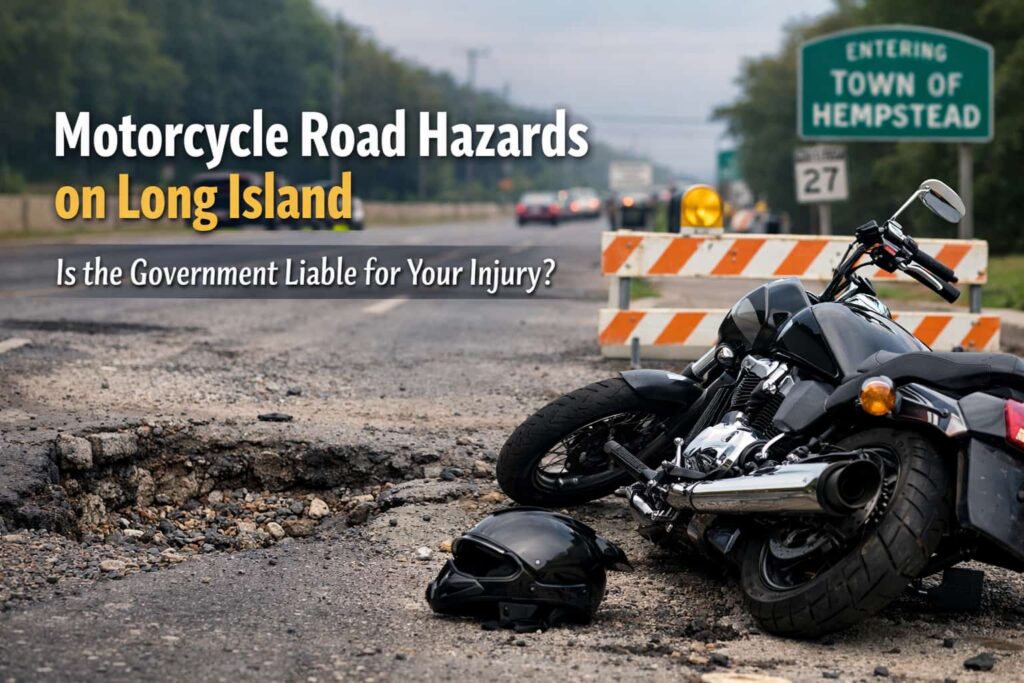
A car driver might barely notice a patch of gravel or a shallow pothole. For a motorcyclist, those same conditions are potentially fatal, and it comes down to basic physics.
A motorcycle balances on two thin tires with contact patches roughly the size of a credit card. Any loss of traction—even for a split second—means an immediate loss of control. A car has four wide tires gripping the road with a combined contact area many times larger. That margin for error simply does not exist on two wheels.
Cars can also straddle potholes and debris. A motorcycle's narrow profile forces you to ride directly over hazards you cannot avoid. And when a car does hit a defect, the driver stays contained inside a steel frame with airbags. When a motorcyclist loses control, the result is sliding across asphalt, impact with fixed objects, or both.
This matters legally because a road defect that is "trivial" for a sedan is a death trap on a motorcycle. We argue that reasonable safety must be judged by the standards of all vehicle types allowed on the road, including motorcycles.
Who Is Responsible for Safe Roads on Long Island?
When you ride on a public road, you are legally considered an invitee. This means that the entity that owns the road—whether it is the State of New York, Suffolk County, or the Town of Hempstead—owes a duty of care to maintain it in a reasonably safe condition for travelers.
However, the government is not a single entity. Determining who is responsible for the pavement under your tires is the first step in any investigation, and it is rarely straightforward.
State Roads vs. Local Roads
The New York State Department of Transportation (NYSDOT) is responsible for state highways, such as the Long Island Expressway (I-495) or the various parkways. Liability for these roads falls under NY Highway Law § 12. Claims here are handled through the Court of Claims, which has its own specific set of rules and filing requirements.
County roads and local town streets have different owners. A pothole on a quiet back road in Islip is the responsibility of the Town of Islip, whereas a major thoroughfare like Nicolls Road falls under Suffolk County jurisdiction. This distinction matters because the deadlines and notice requirements change depending on which government entity controls the road where the crash occurred.
Contractors and Construction Zones
Liability shifts when roadwork is involved. If a private construction company is widening a lane or repaving a surface, they assume a duty of care to motorists. If they leave gravel on a curve or fail to mark a milled surface, they do not enjoy the same governmental immunity protections as a town.
In these scenarios, the claim is typically against the private insurance policy of the construction firm. This simplifies the legal process because private companies cannot hide behind prior written notice statutes the way a municipality can.
Common Motorcycle Road Hazards on Long Island
Long Island's geography and climate create a uniquely dangerous combination for riders. Harsh winters destroy pavement, beach communities track sand across roadways, and constant construction leaves behind gravel and metal plates. Here are the road defects we see most frequently in motorcycle road hazard injury claims.
Potholes and Surface Disintegration
Long Island endures a freeze-thaw cycle that wreaks havoc on pavement. Water seeps into cracks, freezes, expands, and blows out the asphalt—leaving behind jagged craters. Local roads in particular bear the brunt of this damage.
For a motorcycle, hitting a deep pothole with a square edge typically results in a tank slapper or an immediate loss of control. From a legal standpoint, the dimensions of the hole matter. We look at depth, width, and placement. A hole in the center of a lane, where a rider is forced to be, is different from a hole on the shoulder. If the municipality knew about a recurring pothole problem in that spot and only applied temporary patches that washed away, they may be liable for a pothole motorcycle accident.
Loose Gravel, Sand, and Debris
Loose gravel is the invisible ice of motorcycling. It compromises traction instantly, particularly in corners where a sand or gravel motorcycle crash is most likely to occur.
Liability for gravel frequently stems from negligence in cleanup. Under NY Vehicle and Traffic Law § 1219, putting injurious substances on the highway is prohibited. If a construction crew finishes a job but fails to sweep the excess aggregate, they have created a trap. Sand tracked from Long Island's beaches and driveways accumulates at intersections and curves—exactly where riders need traction most. Fallen cargo, blown trash, and vegetation create similar hazards, particularly on parkways and expressways where debris collects along lane edges.
Metal Plates, Uneven Pavement, and Oil Spills
Metal plates covering utility work are dangerously slippery when wet and frequently sit unevenly with the surrounding pavement. Utility cuts, settlement, and poor repairs create height differences and edges that grab motorcycle tires. Oil and fluid spills, especially near gas stations and parking lot exits, eliminate traction without any visible warning.
Each of these hazards contributes to a potential road defect injury claim when the responsible party—whether a municipality, utility company, or property owner—failed to address the condition.
For A Free Legal Consultation, Call
Why You Must Prove the Government Had Prior Notice
The Prior Written Notice Requirement
In most Long Island jurisdictions, you cannot sue a town or county for a roadway defect unless they received prior written notice of that specific hazard. NY Highway Law § 58 provides municipalities with sovereign immunity for road defects, meaning it is not enough that the pothole had been there for six months, nor is it enough to show that the town should have known about it.
Unless someone—a resident, a police officer, a town employee—filed a formal written complaint about that specific pothole before you hit it, the town has immunity.
Complaints made through 311 or to the local highway department may create written notice, but timing matters. The municipality must have had a "reasonable" amount of time to address the defect after receiving the complaint.
How Nassau County Motorcycle Accident Lawyers Investigate a Crash
The burden of proof falls on you to show a paper trail exists. Most people do not file written reports about potholes; they just swerve around them.
At Rosenberg & Gluck LLP, we dig through the records using FOIL (Freedom of Information Law) requests, pulling complaint records, maintenance logs, and inspection reports from the local Department of Public Works to determine if the hazard was previously reported. If we find a match, the immunity is lifted.
Exceptions to the Notice Requirement
If there is no prior written notice, lawyers must rely on one of two legal exceptions to maintain the claim:
- Affirmative Negligence: This applies when the municipality did not just ignore the condition, but actively created it. Because they created the danger, they are presumed to know about it. This eliminates the notice requirement entirely and is typically our strongest angle in cases involving roadwork or botched repairs.
- Special Use: This applies when the defect exists on a part of the road used for a special municipal purpose, like a drainage grate or a manhole cover. If the accident was caused by a sunken manhole cover, the town derives a special benefit from that structure, so they have a higher duty to maintain it regardless of notice.
It can be challenging to understand how your claim falls into these categories, let alone file the required legal paperwork to keep your case on track. For clarity about your legal rights and options, reach out to a motorcycle accident lawyer on Long Island who can assist with the legal burdens while you focus on recovery.
When Private Property Owners Are Liable for Motorcycle Crashes Caused By Road Hazards
Not every motorcycle road hazard on Long Island traces back to the government. Private property owners bear responsibility for dangerous conditions on their property that extend into or affect the public roadway.
Gravel that spills from a commercial driveway onto the street, sand tracked from a beach parking lot onto an adjacent road, or oil pooling at the exit of a gas station—these are all conditions the property owner has a duty to address.
When they fail to maintain safe transitions between their property and public roads, and a rider is injured as a result, the claim falls under standard premises liability rather than the stricter municipal notice requirements.
The 90-Day Deadline (Notice of Claim)

Time is a factor you cannot ignore. In a standard car accident case against another driver, you typically have three years to file a lawsuit. Claims against a municipality operate on a much tighter schedule.
You must file a Notice of Claim within 90 days of the accident.
If you miss this window, you are generally barred from recovering any compensation, no matter how severe your injuries are or how negligent the town was. Many riders make the mistake of waiting until they finish medical treatment to contact a lawyer. By then, the 90-day window has typically closed.
A Notice of Claim is not a lawsuit. It is a formal notification that gives the county or town the right to investigate the incident while the evidence is fresh. It must include specific details about the location, the nature of the defect, and the injuries sustained. If your accident happened on a state road, you must file a Notice of Intention to File a Claim with the New York Court of Claims, or file the claim itself, also generally within 90 days.
FAQs for Motorcycle Road Defect Claims
Can I sue if a pothole caused my motorcycle accident?
Potentially. Pothole motorcycle accident liability depends on whether the municipality that owns the road had prior written notice of that specific defect. If someone reported it before your crash and the town failed to repair it within a reasonable time, you may have a valid claim. If a construction crew or utility company created the pothole, the notice requirement does not apply.
Who is liable for road defects that crash motorcycles?
It depends on who controls the road and who created the hazard. State highways fall under NYSDOT, county roads under the county, and local streets under the town. If a private contractor or property owner caused the condition, they may be liable without the government immunity protections.
What if gravel made me lose control on Long Island?
If the gravel was left by a private contractor, you would sue the construction company. If it was left by a city work crew, you would file a claim against the municipality. We also investigate whether a private property owner allowed gravel or sand to spill from their property onto the roadway.
What if I didn't get a police report at the scene?
Riders are frequently taken away by ambulance before police finish their investigation. You should file an MV-104 form with the DMV within 10 days. We also use ambulance records, 911 call logs, and hospital records to establish the time and location of the accident.
Does my own insurance cover me if I crashed alone?
Only if you carry collision coverage. Unlike cars, motorcycles in New York are not covered by no-fault (PIP) insurance for medical bills. If you only have liability coverage, your own policy will not pay for your bike or your injuries in a solo crash. This makes pursuing the party responsible for the road defect necessary to recover your financial losses.
Rosenberg & Gluck Handles the Investigation. You Focus on Recovery.
After a motorcycle crash caused by a road defect, your priority should be medical care and day‑to‑day recovery, not figuring out which agency owns the pavement or whether prior written notice exists.
Rosenberg & Gluck, LLP can step in quickly to preserve evidence, sort out which municipality or contractor is responsible, and make sure the right notices and claims are filed before critical deadlines—often as short as 90 days—run out.
To learn more about your legal rights and options, schedule a free case evaluation with our experienced Long Island personal injury attorneys. We are available 24/7 to provide legal support in English or Spanish.