Gone are the days when yellow taxis were the sole option because today, the curb is dominated by the digital handshake of rideshare apps like Uber and Lyft. This convenience, however, has introduced a unique and often chaotic element to airport traffic.
The combination of high stress traffic patterns, and the technology that drives the industry creates a perfect storm for accidents. These crashes often result in serious injuries to passengers, other motorists, and pedestrians caught in the airport rush.
At Rosenberg & Gluck, LLP, our Long Island and New York City personal injury attorneys have seen a significant rise in cases stemming from these high-risk areas. An accident involving a rideshare vehicle at JFK or LGA is more complex than a car crash. It requires untangling layers of commercial insurance, local ordinances, and precise digital evidence.
We will illuminate the unique dangers of airport rideshare zones and detail the critical legal steps you must take if you are injured while traveling through these metropolitan hubs.
Call (631) 451-7900 to discuss your case with us.
Key Takeaways
- High-Risk Environment: JFK and LaGuardia are high-stress zones where driver distraction, fatigue, and the pressure of tight traffic choreography lead to a high volume of preventable accidents.
- The Status is Everything: The size of the insurance policy available to compensate you hinges entirely on the rideshare driver's status at the moment of the crash.
- High Commercial Coverage: If the driver has accepted a trip or has a passenger onboard, New York law mandates a high-limit commercial liability policy, often $1.25 Million or more, which is the ideal target for serious injury claims.
- Multiple Defendants: Liability may extend beyond the rideshare driver/company to the Port Authority of New York and New Jersey (PANYNJ) if the crash was caused by poor signage, traffic control, or road design.
- Preserve the Evidence: Immediately after a crash, it is vital to call the airport police, seek medical care, and screenshot all app and trip data before it is permanently deleted by the app provider.
Why JFK and LGA Are Accident Hotspots
The conditions at major New York airports are inherently risky, stacking stress upon complication. This is a meticulously choreographed dance of thousands of commercial vehicles, private cars, and shuttle buses, all operating under extreme time pressure.
| Risk Factor / Legal Issue | JFK Airport (JFK) | LaGuardia Airport (LGA) |
| Primary Pickup/Drop-off Layout | Sprawling terminal loops with long access roads and higher approach speeds | Multi-level parking garages and tight internal ramps |
| Most Common Accident Types | Rear-end collisions on access roads, sudden braking crashes, pedestrian strikes at curbs | Side-swipe collisions, low-speed impacts with columns, rear-end crashes inside garages |
| Driver Risk Factors | Speed variation, fatigue after long trips, abrupt traffic compression near terminals | Confusion navigating garage levels, distracted driving while following app instructions |
| Pedestrian Risk Level | High – wide curbs with distracted travelers pulling luggage | Very High – pedestrians sharing confined garage spaces with moving vehicles |
| Typical Rideshare Driver Status at Crash | Often Trip Accepted / Passenger Onboard | Often App On / Waiting or Trip Accepted |
| Likely Insurance Coverage Tier | Tier 3 – Commercial Policy ($1.25M–$1.5M) | Tier 2 or Tier 3 depending on app status |
| Potential Additional Liable Party | Port Authority of NY & NJ (PANYNJ) for roadway design or signage | Port Authority of NY & NJ (PANYNJ) for garage design, signage, and traffic control |
| Key Evidence to Preserve | App status, GPS logs, access road location, police report | App status, garage level/pillar number, surveillance footage |
1. Zero Margin for Error
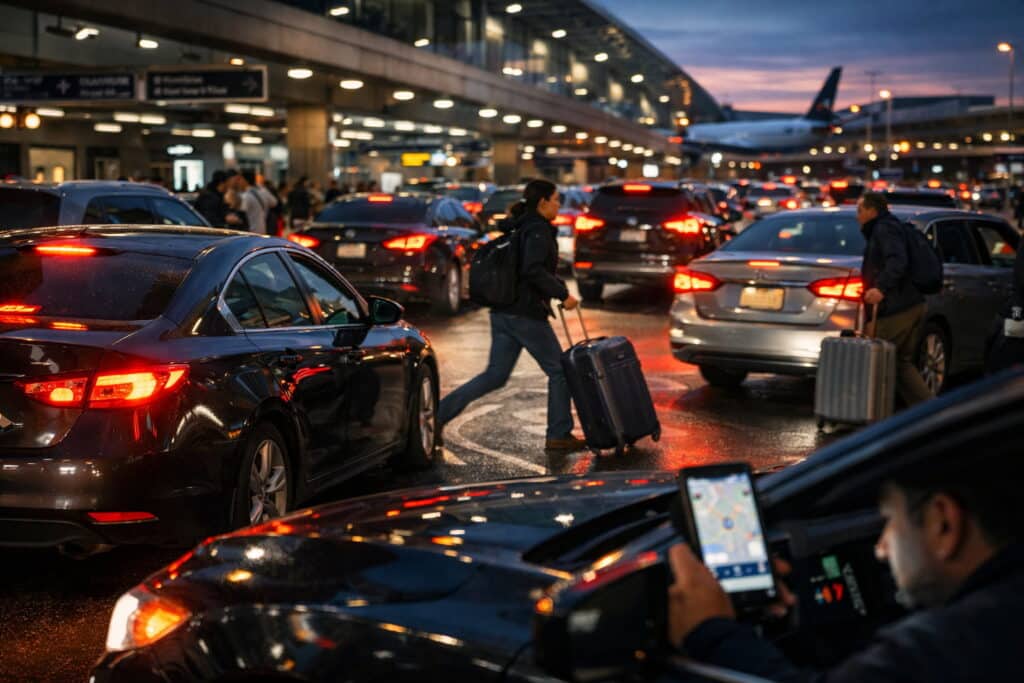
Airport pickup and drop-off zones are designed for throughput, not safety margins. Lanes are tight, curbs are crowded, and signs are confusing. Drivers are forced to navigate this gauntlet while simultaneously monitoring an app, checking their rearview, and scanning the curb for a passenger's face.
2. Confusing Traffic Flow (The LaGuardia Example)
The massive redevelopment at LaGuardia, while modernizing the airport, created a temporary and convoluted traffic environment. Pickups at terminals like Terminal B often require drivers to navigate to a specific level of a parking garage, a highly unnatural and stressful place for commercial passenger pickup.
- Terminal B: Riders are often instructed to meet drivers on Level 2 of the parking garage. This requires drivers to maneuver through columns and tight ramps while focusing on their GPS, leading to side-swipe and rear-end collisions.
- JFK: The sprawling nature of JFK, with its various rings and terminal access roads, means rideshare drivers are often traveling at higher speeds on access roads, only to slam on the brakes upon entering the congested drop-off loop.
3. The Pedestrian Factor
Travelers are often distracted. They are pulling luggage, looking at their phones, and searching for the blue and white sign of their designated pickup spot. This vulnerability means that a driver making an illegal curbside stop or a quick U-turn in a restricted area can easily cause catastrophic injury to a pedestrian who assumed the curb was safe.
Why Rideshare Drivers Crash at Airports
The accident statistics clearly show that rideshare drivers face unique pressures that contribute to negligence, especially in high-volume, high-stress environments like JFK and LGA.
1. Distracted Driving
This is the single leading cause of accidents involving rideshares. The driver's job requires constant interaction with a smartphone: accepting the ride, confirming the passenger, driving unfamiliar airport roads, and checking for the next ride immediately after drop-off. In the tight quarters of an airport curb, even a two-second glance at the app can result in:
- A rear-end collision with the car in front that suddenly stopped.
- A sideswipe while attempting a hurried lane change to find the correct pillar.
- Hitting a pedestrian emerging from between parked cars.
2. Driver Fatigue and Time Pressure
Rideshare drivers are independent contractors, not employees. They often work long hours, sometimes combining driving with other jobs, in an effort to meet high quotas or minimum hourly rates. Driving while fatigued is medically proven to be as dangerous as driving while intoxicated.
The pressure to get out of the airport loop and back to the staging lot pushes drivers to make risky decisions, such as speeding on airport access roads or making illegal, last-minute lane cuts.
3. Unfamiliarity and Confusion
New York City has thousands of rideshare drivers who may operate across multiple boroughs, and many are not familiar with the constant changes and specific rules of the airport terminals.
A driver who relies solely on GPS, which often lags or misinterprets airport ramps, is liable to suddenly slam on the brakes, pull over illegally, or attempt an improper maneuver, creating an immediate hazard.
Decoding Rideshare Insurance in New York
If you are involved in an accident at JFK or LGA, the identity of the insurance company, and the size of the policy, hinges entirely on one factor: the driver's status on the app at the exact moment of the crash.
This is the most critical element of a rideshare injury claim, and it's what separates an experienced rideshare accident lawyer from a general practitioner. New York's specific regulations governing Transportation Network Companies (TNCs) mandate three distinct tiers of insurance coverage:
Tier 1: App Off (Personal Use)
- Status: The driver is not logged into the rideshare app.
- Insurance: Only the driver's personal auto insurance policy applies.
- Problem: This policy may be low-limit (often $25,000 per person) and may even deny coverage if they find the driver was secretly heading toward the airport for work.
Tier 2: App On / Waiting for a Request
- Status: The driver is logged into the app and waiting for a ride request. This is common in the airport staging/holding lots.
- Insurance: TNC-provided coverage kicks in, but it is limited (often around $50,000 to $100,000 for bodily injury).
- Risk: If the crash happens in the designated holding lot or on the airport access road before accepting a fare, you are limited to this coverage tier.
Tier 3: Trip Accepted / Passenger Onboard (The Commercial Policy)
- Status: The driver has accepted a trip request and is either en route to the passenger or the passenger is already in the vehicle.
- Insurance: High-limit commercial liability coverage of $1.25 Million or $1.5 Million applies for death, bodily injury, and property damage.
- The Goal: Our primary focus is almost always to prove the driver was in this high-limit window, as it provides the necessary resources to compensate for catastrophic injuries, lost wages, and long-term medical care.
The New York No-Fault Exception
New York is a "No-Fault" state, which typically requires a victim to meet a "serious injury" threshold to sue a negligent driver. However, New York law is often interpreted to exempt passengers and third parties injured in accidents involving TNCs from this limitation, allowing us to pursue a claim against the at-fault driver's insurance more easily.
Liability Beyond the Rideshare Driver
The driver's negligence is often the direct cause, but in the airport environment, other parties may bear responsibility under New York's comparative negligence laws.
1. The Other Negligent Driver
In many airport crashes, the rideshare driver is rear-ended by another impatient driver, or they are involved in a chain-reaction collision. We will simultaneously pursue a claim against the non-rideshare driver's insurance.
2. The Port Authority of New York and New Jersey (PANYNJ)
As the operator of JFK and LaGuardia, the PANYNJ is responsible for traffic management, signage, road design, and maintenance. If the accident was caused or worsened by:
- Confusing or inadequate signage.
- Poorly designed pickup/drop-off loops.
- Missing or broken traffic signals.
- Dangerous pavement conditions.
We may file a Notice of Claim against the PANYNJ, arguing that their failure to maintain a safe environment contributed to your injuries. Suing a public authority is highly nuanced and requires strict adherence to short deadlines and procedural rules, an area where our experience is essential.
Critical Steps After an Airport Rideshare Crash
The frantic pace of an airport environment means evidence can vanish instantly. Time is the enemy of a successful claim.
1. Seek Immediate Medical Attention
Adrenaline and the stress of travel can mask injuries like whiplash, concussions, or herniated discs. Airport crashes, often involving sudden, low-speed impacts, frequently cause these soft-tissue injuries. Your health is paramount, and early medical documentation is the bedrock of your legal case.
2. Call Airport Police/Security Immediately
Do not rely on the rideshare driver to call 911. Airports have their own police or dedicated security forces. A formal police report or incident report is vital for documenting lane usage, time of the crash, and the identity of the driver and passenger.
3. Preserve Digital Evidence
Before the app can erase or update the trip data, screenshot everything:
- The driver’s name and license plate.
- Your trip receipt showing the exact time and location of the pickup/drop-off.
- The exact pickup zone/pillar number.
- The driver’s app screen, if possible (to prove their status).
- Crucially: Notify your attorney immediately so we can send a spoliation letter to the rideshare company, legally forcing them to preserve the driver's GPS logs, app records, and internal communications, which often disappear within days or weeks.
4. Do Not Give a Statement to the Insurers
The insurance adjusters, especially those working for the TNC’s high-limit commercial carrier, will contact you quickly. They are trained to minimize your injuries and settle your claim for pennies. Direct all inquiries to your legal team.
Why We Are Your Necessary Co-Pilot
Dealing with the liability maze of a JFK or LaGuardia rideshare accident requires a legal team with immense knowledge and local experience.
- We Understand the Tiers: We know how to obtain the necessary digital evidence to prove the driver was in the $1.25 Million+ coverage tier, maximizing your potential recovery.
- We Know the Entities: We have the experience to hold not just the driver accountable, but also the Port Authority or the city, understanding the strict procedural requirements for filing claims against municipal bodies.
- Local Court Experience: As Long Island and New York City attorneys, we are familiar with the court venues where these cases are litigated. We know the courts, the judges, and the local defense attorneys.
Your Damages Are Real
If you were injured at an airport, you are likely facing significant losses:
- Massive medical bills.
- Lost wages from canceled travel or time off work.
- Pain and suffering, and psychological trauma.
Do Not Delay Your Claim
The convenience of rideshare apps at JFK and LaGuardia comes with a hidden cost of increased risk and legal nuance. While you focus on recovering from your injuries and rescheduling your life, let the attorneys at Rosenberg & Gluck, LLP shoulder the burden of the legal battle.
If your trip through New York’s airports was derailed by a negligent rideshare driver, you have rights, and potentially access to substantial corporate insurance policies. Do not let an insurance adjuster convince you otherwise.
We will investigate the driver's app status, preserve the critical evidence, and fight to secure the compensation you may deserve. You don't pay us a fee unless we win your case.
Call us today at (631) 451-7900 for a free, no-obligation consultation.