
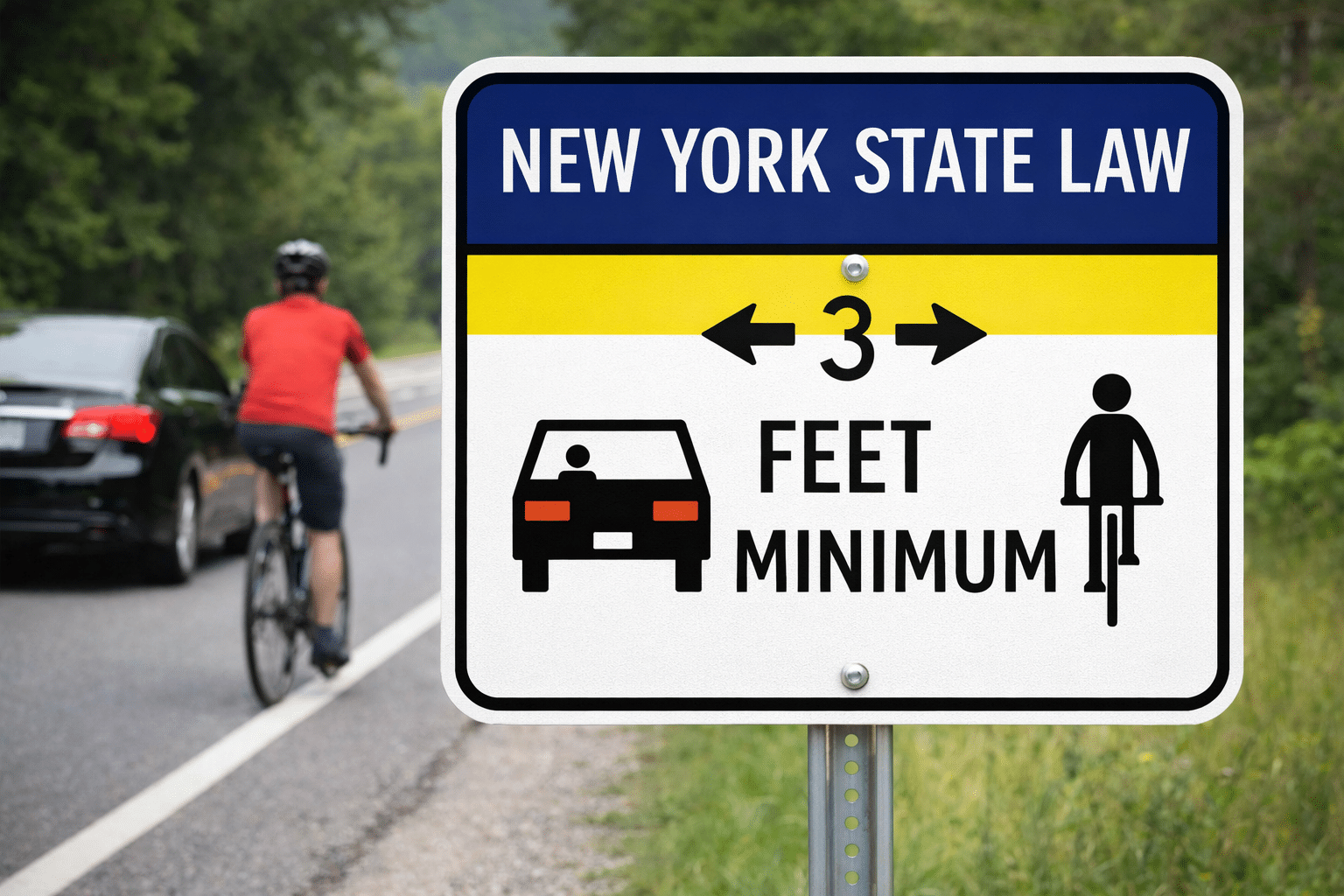
Cycling has exploded in popularity across New York, particularly on Long Island. More people are on two wheels than ever before. However, with increased ridership comes increased conflict between bicycles and motor vehicles.
One of the most common types of accidents involves a vehicle overtaking a cyclist. To combat this, safety advocates have long pushed for a “Three-Foot Passing Law.” But for many New Yorkers, the law remains a source of confusion. Is it a state law? Is it a county law? And what actually constitutes a “safe distance”?
At Rosenberg & Gluck, LLP, we see the devastating consequences of these collisions firsthand. In this guide, we break down the current legal environment of passing laws in New York, the specific protections available in Suffolk County, and how these laws impact liability in personal injury cases.
Call us today at (631) 250-4072 to discuss your case.
Key Takeaways
- State vs. Local: While New York State law requires a “safe distance,” Suffolk County specifically mandates a 3-foot minimum passing distance.
- Physics Matters: The 3-foot rule is designed to account for wind shear from passing vehicles and the need for cyclists to swerve around road obstacles.
- Liability: Violating the 3-foot rule is strong evidence of negligence. If a driver hits you while passing, they likely failed in their duty of care.
- Defensive Riding: Cyclists are legally allowed to “take the lane” if the road is too narrow to be shared safely side-by-side.
- Immediate Action: If hit, preserve your bike as evidence and contact a lawyer who understands the nuances of VTL § 1122-a and local ordinances.
The “Safe Distance” Debate: New York State Law
To understand the “Three-Foot” rule, we first have to look at the existing state law. For years, New York State Vehicle and Traffic Law (VTL) has been somewhat ambiguous regarding exactly how much space a driver must give a cyclist.
VTL § 1122-a: Overtaking a bicycle under current New York State law, the operator of a vehicle overtaking a bicycle must pass “at a safe distance until safely clear thereof.”
The problem lies in the definition of “safe.” To a cyclist, “safe” might mean a wide berth that accounts for wind gusts and road debris. To a driver in a rush, “safe” might mean squeezing by with six inches to spare. This ambiguity leaves room for argument in court and, unfortunately, tragedy on the roads.
The Push for Statewide Definition
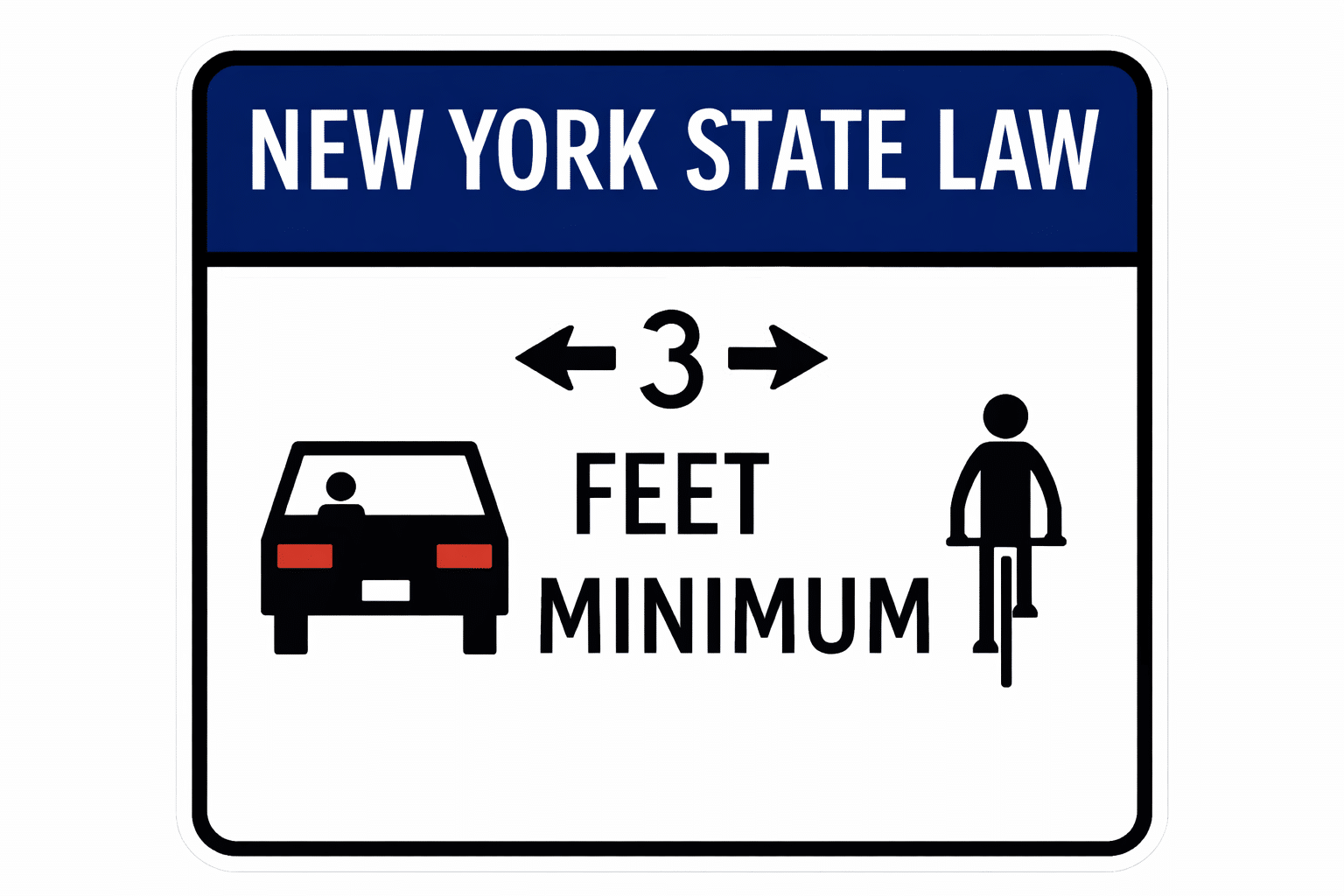
Because of this ambiguity, advocacy groups like the New York Bicycling Coalition have championed the “Defined Safe Passing” bill (S.1665/A.01831). This legislation aims to mandate a statewide minimum passing distance of three feet.
While this bill has seen varying degrees of progress in the State Senate and Assembly, it highlights a critical gap in statewide safety standards. However, if you are driving or riding on Long Island, the rules are different, and stricter.
The Suffolk County 3-Foot Law
While Albany debates, local governments have taken action. Suffolk County has its own specific legislation that removes the ambiguity of the state law. Passed in 2021, the Suffolk County 3-Foot Passing Law requires motorists to allow a minimum of three feet of distance between their vehicle and a bicyclist when passing.
Why This Matters for Long Island Cases
This local law is a powerful tool for accident victims in Suffolk County. In a personal injury case, proving negligence is key.
- Under State Law: We must argue that the driver failed to exercise “due care” and didn’t provide a “safe distance”, a concept open to interpretation by a jury.
- Under Suffolk Law: If we can prove the driver was within three feet of the cyclist at the time of the crash (or the pass that caused the crash), they have violated a specific statute. This can be used as strong evidence of negligence.
This distinction is vital for cyclists in towns like Brookhaven, Riverhead, Smithtown, and Islip. You have protections here that are more explicit than in many other parts of the state.
| Legal Framework | New York State Law (VTL § 1122-a) | Suffolk County 3-Foot Passing Law |
| Governing Authority | New York State | Suffolk County, NY |
| Required Passing Distance | “A safe distance” (not defined) | Minimum 3 feet of lateral clearance |
| Level of Specificity | Broad and subjective | Clear, objective, and measurable |
| Room for Driver Interpretation | High — “safe” varies by perception | Low — distance is fixed by statute |
| Ease of Proving a Violation | Moderate to difficult | Easier with video, witnesses, or reconstruction |
| Impact on Liability | Used as evidence of negligence | Strong evidence of negligence when violated |
| Protection for Cyclists | General duty of care | Explicit, enhanced local protection |
| Importance in Injury Claims | Requires argument and jury interpretation | Allows direct statutory violation argument |
The Physics of Passing
Why is three feet the magic number? It isn’t arbitrary. It is based on the physics of moving vehicles and the unpredictable nature of road surfaces.
1. The Wind Buffer
When a large vehicle passes a cyclist at high speed, it pushes a wall of air ahead of it and creates a suction vacuum behind it.
- The Push: As the vehicle approaches, the air pressure can push the cyclist toward the curb or off the road.
- The Pull: As the vehicle passes, the suction can pull the cyclist into the side of the vehicle.
- The Result: Without a 3-foot buffer, a cyclist can be destabilized and crash without the vehicle ever physically touching them.
2. Obstacle Avoidance
Cyclists rarely ride in a perfectly straight line because roads aren’t perfect. Potholes, glass, sewer grates, and roadkill force cyclists to swerve slightly to the left.
- If a driver is passing with only 12 inches of clearance, and the cyclist swerves 6 inches to avoid a pothole, a collision is almost inevitable.
- A 3-foot buffer allows for these necessary micro-adjustments.
3. Reaction Time
If a driver is passing too closely and the cyclist falls, a close-following driver has zero time to react. Distance equals time.
Liability and Negligence: The Legal Perspective
We focus on holding negligent drivers accountable. When a “failure to yield” or “unsafe passing” accident occurs, we look at several factors to build a case.
Negligence Per Se vs. Evidence of Negligence
In legal terms, violating a statute can sometimes constitute negligence per se. This means the act itself is deemed negligent because it violated a law designed to protect a specific class of people from a specific harm. Even where it isn’t automatic negligence per se, it is powerful evidence of negligence.
Proving the Distance
You might ask: How do you prove the driver was less than three feet away? This is where our investigative resources come into play.
- Video Evidence: GoPro cameras on bikes and dashcams in cars are becoming standard. We analyze this footage frame-by-frame.
- Witness Statements: Independent witnesses can often testify that a driver “buzzed” the cyclist or came “dangerously close.”
- Physical Evidence: Scuff marks on the vehicle, handlebar damage, and the resting position of the bike can allow accident reconstructionists to calculate the impact angle and proximity.
- “Dooring” Context: Sometimes, a driver swerves to avoid a parked car door and hits a cyclist, or squeezes a cyclist into the “door zone.” The 3-foot law applies to the lateral distance from the cyclist, regardless of other obstacles.
How to Share the Road
Whether you are behind the wheel or behind the handlebars, understanding how to navigate these laws is essential for preventing accidents.
For Drivers: How to Pass Safely
Many drivers on Long Island roads, which are often narrow and lack shoulders, feel frustrated when stuck behind a cyclist. Here is how to handle it legally and safely:
- Patience is Key: If you cannot give 3 feet, you cannot pass. You must wait until the road widens or traffic clears. Saving 30 seconds is not worth endangering a life.
- Crossing the Double Yellow: This is a common point of confusion. In some jurisdictions, laws explicitly allow drivers to cross a double yellow line to pass a cyclist if it is safe to do so. In New York, the law is stricter regarding double yellow lines. However, drivers are expected to exercise “due care.” If you can see clearly that the opposing lane is empty, giving the cyclist room is the priority. If you cannot see, do not pass.
- Check Your Mirrors: Before moving back into the lane after passing, ensure you see the cyclist in your rearview mirror, not just your side mirror. Cutting back in too early is a common cause of accidents.
For Cyclists: Riding Defensively
While the law is on your side, physics is not. You are vulnerable.
- Take the Lane: If the lane is too narrow for a car and a bike to share safely (less than 14 feet wide), New York law generally allows you to move toward the center of the lane. This forces drivers to change lanes to pass you rather than trying to squeeze past you in the same lane.
- Use Lights and Cameras: High-visibility lights make it harder for drivers to claim “I didn’t see them.” A helmet camera provides the objective evidence we need to win your case if you are hit.
- Signal Your Intentions: If you need to move left to avoid a pothole, hand signal early. Don’t surprise the driver behind you.
Common Defense Tactics (And How We Beat Them)
When we represent injured cyclists, insurance companies often try to shift the blame to the victim. Here are common defenses we encounter regarding passing accidents:
1. “The Cyclist Swerved”
The Defense: The driver claims they gave enough room, but the cyclist suddenly swerved into the car.
Our Rebuttal: We look at the road conditions. Was there a pothole? Did the cyclist have to swerve? Furthermore, if the driver had truly given three feet of clearance, a minor swerve wouldn’t have resulted in contact. The 3-foot buffer is specifically designed to account for such movements.
2. “The Cyclist Should Have Been on the Shoulder”
The Defense: The driver argues the cyclist was “in the middle of the road” and shouldn’t have been there.
Our Rebuttal: VTL § 1234 requires cyclists to ride near the right-hand curb or edge of the roadway, but there are massive exceptions:
- When preparing for a left turn.
- When conditions make the right edge unsafe (debris, drainage grates, parked cars).
- When the lane is too narrow to share. We vigorously defend a cyclist’s right to use the full lane when safety dictates it.
3. “The Sun Was in My Eyes”
The Defense: A driver claims sun glare prevented them from seeing the cyclist or judging the distance.
Our Rebuttal: Sun glare is a known condition, not an unexpected emergency. Drivers have a duty to slow down or stop if they cannot see. Blinding sun does not excuse hitting a person as it increases the duty of care.
What to Do If You Are Hit by a Passing Car
If you are involved in a sideswipe or overtaking accident, the steps you take immediately afterward are critical.
- Seek Medical Attention: Go to the ER or urgent care immediately.
- Do Not Negotiate: The driver may apologize and offer cash to fix your bike. Do not accept it. You may have adrenaline masking serious injuries that won’t appear for hours.
- Call the Police: You need an official Accident Report (MV-104). Ensure the officer records your version of events. If the driver passed too closely, state clearly: “The driver did not give me safe clearance.”
- Preserve Your Bike: Your bicycle is evidence. Do not fix it. Do not throw away your torn jersey or cracked helmet. These show the point of impact.
- Call Us: Bicycle accident cases are unique. They involve specific laws that general practitioners may not fully grasp.
Why Choose Us for Bicycle Accidents?
We are Long Islanders who understand our local roads.
- We know the dangerous stretches of Route 25A.
- We know the blind spots on the backroads of the Hamptons.
- We understand the specific statutes in Suffolk County versus NYC.
We have successfully represented cyclists who were blamed for their own accidents, uncovering video footage and witness testimony that proved the driver failed to pass safely.
The Cost of a “Close Pass”
A violation of the passing law might result in a small fine for the driver. But for the cyclist, it can result in:
- Fractured clavicles and limbs.
- Road rash requiring skin grafts.
- Traumatic Brain Injury (TBI).
- PTSD and fear of riding.
You may deserve compensation not just for your medical bills, but for your pain, suffering, and the loss of your enjoyment of cycling.
Three-Feet, Countless Lives
The “Three-Foot Passing Law”, whether as a specific county ordinance or a general interpretation of “safe distance”, is about respect for human life. At Rosenberg & Gluck, LLP, we support every effort to make New York’s roads safer for cyclists.
Until every driver understands the importance of that three-foot buffer, we will be here to fight for those who are injured when that safety zone is violated. If you or a loved one has been injured in a bicycle accident on Long Island, do not rely on an insurance company to tell you what your rights are.
Call us today at (631) 250-4072 for a free consultation.
For A Free Legal Consultation, Call